Typical CMU Block Dimensions: Standard Sizes Explained
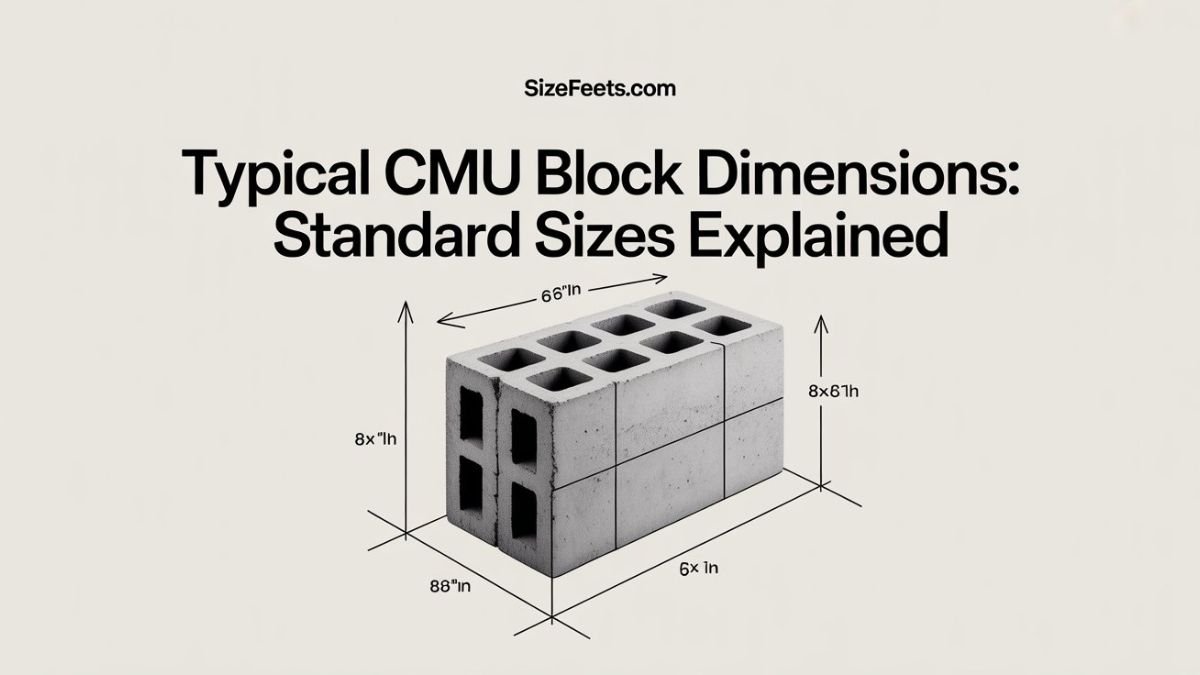
Typical cmu block dimensions describe how big a concrete block is. The actual size is 7⅝ by 7⅝ by 15⅝ inches. The nominal size is 8 by 8 by 16 inches. The block is ⅜ inch smaller for mortar. This is the most common block size.
Have you ever wondered why a block is not a clean 16 inches? The mortar joint is the reason. The block plus mortar fills the grid. A ruler plus a bit matches the length. Once you see this, the sizing makes sense.
The block uses two sizes: nominal and actual. The ⅜-inch gap is for the mortar joint. A standard block weighs about 38 pounds. Two bricks match the block’s length. These facts make typical cmu block dimensions easy to picture.
Typical CMU Block Dimensions in Different Units
A concrete masonry unit (CMU) is sized by a nominal and an actual measurement. The common block has a nominal size of 8 × 8 × 16 inches, but the actual size is 7⅝ × 7⅝ × 15⅝ inches (194 × 194 × 397 mm). The ⅜-inch gap leaves room for the mortar joint. Here’s the breakdown.
| Measurement | Nominal | Actual (in) | Actual (mm) |
| Height | 8 in | 7⅝ in | ~194 mm |
| Depth (width) | 8 in | 7⅝ in | ~194 mm |
| Length | 16 in | 15⅝ in | ~397 mm |
| Mortar joint | — | ⅜ in | ~10 mm |
| Weight (standard) | — | ~38 lb | ~17 kg |
| Weight (lightweight) | — | ~28 lb | ~13 kg |
The nominal size includes the mortar joint, so blocks fit a grid. A block plus its mortar equals a clean 8 or 16 inches. This is why builders plan walls using nominal sizes, even though each block is actually ⅜ inch smaller.
Quick Reference Table
Want the fast version? This chart shows the typical CMU block dimensions and everyday objects that match. All figures are approximate unless marked exact.
| Element | Size | Visual / Notes | Best For |
| Actual height | 7⅝ in | About a soda can’s height | Block height |
| Actual length | 15⅝ in | About a ruler plus a bit | Block length |
| Actual depth | 7⅝ in | About a soda can’s height | Block depth |
| Nominal size | 8 × 8 × 16 in | The grid size | Planning walls |
| Mortar joint | ⅜ in | About a stack of 4 coins | Joint gap |
| A standard brick ×2 | ~8 in each | Two bricks long | Length cue |
| A sheet of paper (length) | 11 in | Shorter than block | Length cue |
| A shoebox | ~13 in long | Close to length | Size cue |
12 Everyday Things That Match CMU Block Dimensions
Here are 12 objects that help you picture the typical CMU block dimensions without a tape measure. Some match the height, some the length, and a few show the whole block.
A Ruler Plus 3.6 Inches (Block Length)
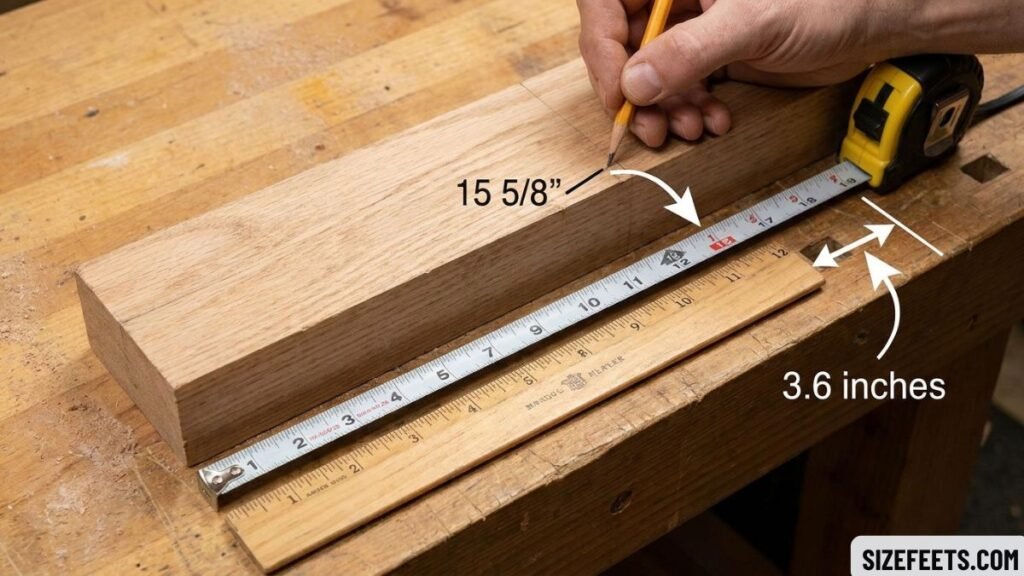
The block length is 15⅝ inches, close to a standard ruler plus about 3.6 inches. A ruler is 12 inches, so the block is a bit over a ruler and a quarter. Picture a ruler with a little over three and a half inches added.
The 15⅝-inch actual length plus a ⅜-inch mortar joint equals a clean 16 inches, the nominal size. This lets blocks fit a 16-inch grid, matching common wall spacing. Because a ruler is a familiar length, it’s an easy way to picture the block. If you lay a ruler down and add a bit over 3.6 inches, you’ve got the block’s length. It’s the longest dimension of a standard CMU.
A Soda Can (Block Height)
The block height is 7⅝ inches, close to a soda can plus a bit. A soda can is about 4.8 inches tall, so the block is a bit over one and a half cans. Picture about one and a half cans stacked to see the height.
The 7⅝-inch actual height plus a ⅜-inch mortar joint equals a clean 8 inches, the nominal size. This lets blocks stack in an 8-inch grid. Because a soda can is a familiar object, it helps you picture the height. If you imagine one and a half soda cans stacked, that’s close to a block’s height. Both the height and depth of a standard block are 7⅝ inches, so they match.
Two Standard Bricks (Length)
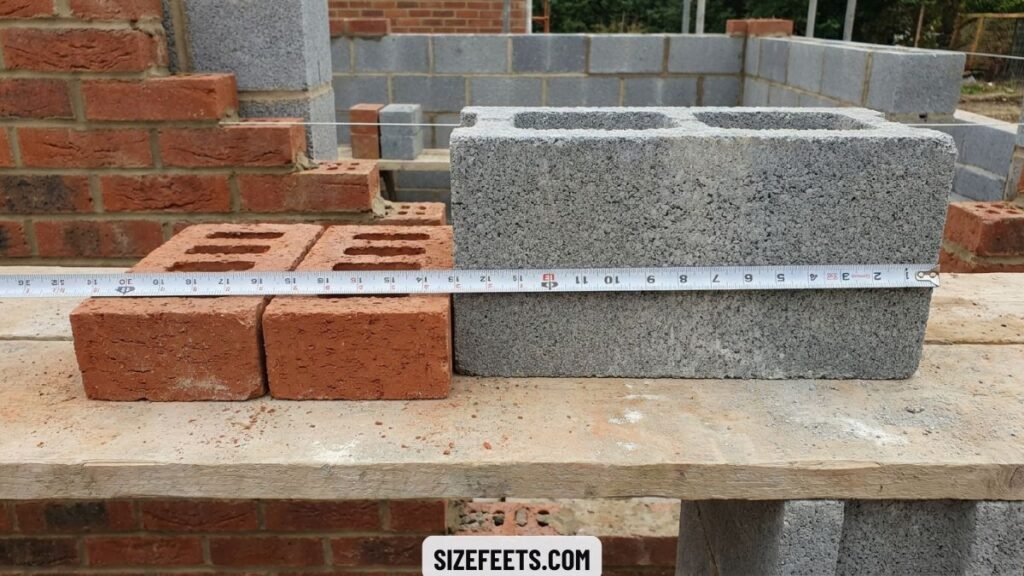
Two standard bricks laid end to end are close to the block length. A standard brick is about 8 inches long, so two make 16 inches, matching the block’s nominal length. Picture two bricks in a row to see the length.
Bricks and CMU blocks are both used in walls, often together. A standard modular brick is about 8 inches long, so two equal one block’s nominal length. Because bricks are a familiar building material, they make a good comparison. Two bricks end to end match a CMU block’s 16-inch grid length. This is why bricks and blocks work together in construction, sharing the same modular sizing for clean, even courses.
A Shoebox (Whole Block)
A shoebox is close to the size of a whole CMU block. A men’s shoebox is about 13 to 14 inches long, 8 inches wide, and 5 inches tall, close to the block’s length and depth. Picture a shoebox to see the overall size.
Shoeboxes are made of cardboard, sized to hold a pair of shoes. Their length and width are close to a CMU block’s, though the block is taller and much heavier. Because a shoebox is a familiar object, it makes a handy size reference. If you picture a large shoebox, you’ve got a rough idea of a block’s footprint. The block is a solid, heavy version of that boxy shape, made of concrete.
A Sheet of Paper (Length Comparison)
A sheet of paper helps you picture the block length. US letter paper is 11 inches long, so a CMU block at 15⅝ inches is the paper plus about 4.6 inches. Picture a sheet of paper with a bit added.
Letter paper is a standard office size, familiar to almost everyone. A CMU block is longer than a sheet of paper, by about 4.6 inches. Because paper is in every home and office, it makes a handy comparison. If you lay a sheet of paper down and imagine adding about four and a half inches to the long side, you’ve got the block’s length. It’s an easy way to picture the size using a common item.
Four Stacked Coins (Mortar Joint)
Four stacked coins are close to the mortar joint. The standard mortar joint is ⅜ inch (10 mm), close to a stack of about five US quarters, since each is about 0.069 inches thick. Picture a small stack of coins to see the joint gap.
The ⅜-inch mortar joint is the space between blocks, filled with mortar to bond them. This gap is what makes the actual block ⅜ inch smaller than the nominal size. Because coins are a familiar thickness, they help you picture the joint. A stack of about five quarters equals the ⅜-inch gap. This small but key measurement is why builders plan with nominal sizes that include the mortar.
A Loaf of Bread (Whole Block)
A loaf of bread is close to the size of a CMU block. A standard loaf is about 12 inches long, 5 inches wide, and 5 inches tall, a bit shorter than a block. Picture a loaf to see a rough version of the block’s shape.
Bread loaves are a familiar kitchen item, sized for slicing. A CMU block is longer and taller than a loaf, but the boxy shape is similar. Because a loaf is easy to picture, it makes a handy comparison. If you imagine a large loaf of bread stretched a bit longer and taller, you’ve got a block’s rough size. The block, of course, is solid concrete and far heavier than bread.
A Standard Brick (Height Comparison)
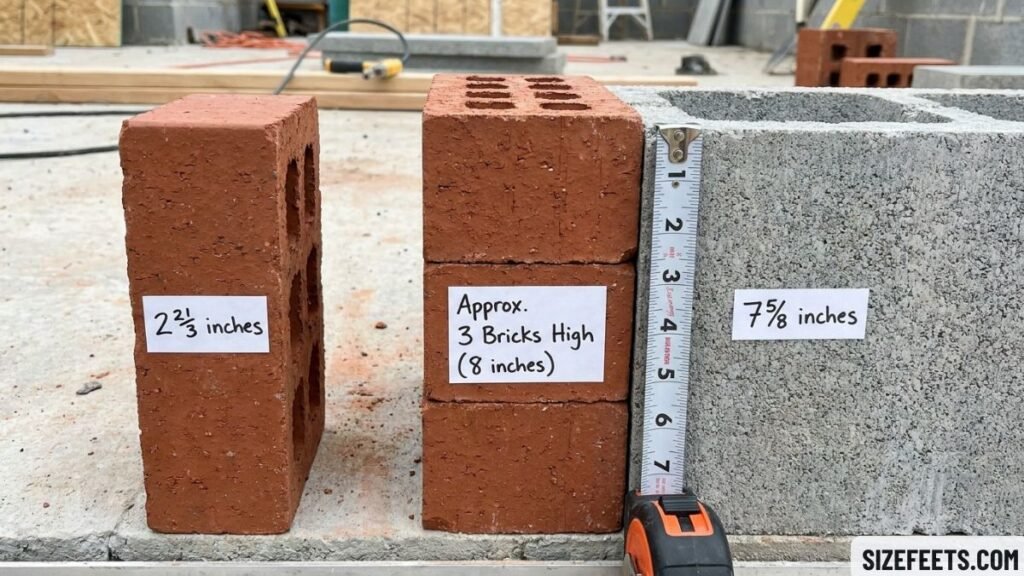
A standard brick helps you picture part of the block. A brick is about 2⅔ inches tall, so a CMU block at 7⅝ inches is close to three bricks stacked. Picture three bricks on top of each other to see the block height.
In a wall, three courses of standard brick roughly equal the height of one CMU block, which is why they work together. A brick is much smaller than a block. Because bricks are a familiar building material, they make a good height comparison. Three stacked bricks are close to one block’s height. This modular match is why builders can combine bricks and blocks in the same wall with even, aligned courses.
A Laptop (Length Comparison)
A laptop helps you picture the block length. A 15-inch laptop is about 14 inches wide, close to the block’s 15⅝-inch length. Picture a laptop to see the length.
Laptops are measured by screen size on the diagonal, but a 15-inch model’s body is about 14 inches wide. That’s close to a CMU block’s length. Because a laptop is a familiar object, it makes a handy comparison. A block is a bit longer than a 15-inch laptop is wide. If you picture a laptop with about an inch and a half added to its width, you’ve got the block’s length. It’s an easy tech-based reference.
A Two-Liter Bottle (Height Comparison)
A two-liter soda bottle helps you picture the block height. two-liter bottle is about 12 inches tall, so a block at 7⅝ inches is about two-thirds of the bottle. Picture the lower part of a two-liter bottle to see the height.
Two-liter bottles are common drink containers, familiar in most homes. A CMU block is shorter than a two-liter bottle, at about two-thirds its height. Because the bottle is a known size, it makes a handy comparison. If you picture a two-liter bottle and imagine the bottom two-thirds, that’s close to a block’s height. It’s an easy kitchen reference for the 7⅝-inch height of a standard block.
A Cinder Block’s Weight (Feel Comparison)
The weight helps you picture a standard block. A standard CMU weighs about 38 pounds, close to a medium bag of dog food or a large bag of flour times three. Picture lifting a heavy bag to feel the weight.
Standard concrete blocks are dense and heavy, at about 38 pounds each. Lightweight blocks weigh less, around 28 pounds. Because a bag of dog food or a few flour bags is a familiar weight, it helps you picture the heft. A single block is a real load to lift, which is why builders use care when stacking them. This weight is part of why CMU walls are so strong and stable.
A Toaster (Whole Block)
A toaster is close to the size of a CMU block. A two-slice toaster is about 11 inches long, 7 inches wide, and 8 inches tall, close to the block’s height and depth. Picture a toaster to see a rough version of the block.
Toasters are common kitchen appliances, boxy and compact. A CMU block is a bit longer than a toaster but similar in height and depth. Because a toaster is a familiar object, it makes a handy size reference. If you picture a two-slice toaster stretched a bit longer, you’ve got a rough idea of a block’s size. The block, of course, is solid concrete and much heavier than a toaster.
How to Measure a CMU Block Without a Tape Measure
No tape handy? These simple tricks help you estimate a CMU block’s size using things you already have.
Use a Ruler for the Length
A ruler gets you close to the block length. Since a ruler is 12 inches and the block is 15⅝ inches, lay a ruler along the block and add about 3.6 inches past the end. That total is the block’s length. This works well when you have a ruler but no tape. Because the block length is just over a ruler and a quarter, it’s easy to estimate this way with a common desk or toolbox item.
Stack Soda Cans for the Height
Soda cans help you check the height. Since a soda can is about 4.8 inches tall and the block is 7⅝ inches, one and a half cans stacked reach close to the block’s height. Set a block next to about one and a half cans to compare. Because cans are a familiar size, this gives a quick height check with no tape, using drinks from your fridge.
Use Bricks for the Grid
Bricks match the block’s modular sizing. A standard brick is about 8 inches long, so two end to end equal a block’s 16-inch nominal length. Three bricks stacked equal about one block’s height. Lay bricks against a block to check its size. Because bricks and blocks share the same grid, this is a handy way to gauge block dimensions using another common building material.
CMU Block Dimensions vs. Other Building Units
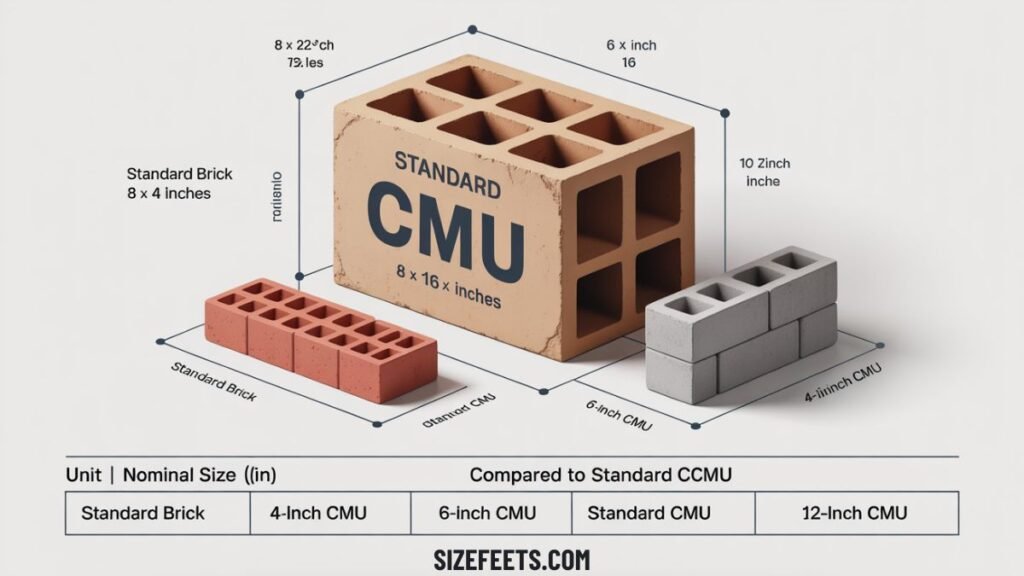
Seeing the CMU block next to other units builds a clear picture. A standard CMU block is 8 × 8 × 16 inches nominal. A standard brick is much smaller, about 8 × 2⅔ × 4 inches. A 4-inch CMU is a half-depth block at 4 × 8 × 16 inches. And a 12-inch CMU is a deeper block at 12 × 8 × 16 inches. So the 8-inch block is the common middle size, sharing its length with most CMU units.
| Unit | Nominal Size (in) | Compared to Standard CMU |
| Standard brick | 8 × 2⅔ × 4 | Much smaller |
| 4-inch CMU | 4 × 8 × 16 | Half the depth |
| 6-inch CMU | 6 × 8 × 16 | Less depth |
| Standard CMU | 8 × 8 × 16 | The base block |
| 12-inch CMU | 12 × 8 × 16 | Deeper |
Frequently Asked Questions
What is the size of a standard CMU block?
A standard CMU block is 7⅝ × 7⅝ × 15⅝ inches actual, or a nominal 8 × 8 × 16 inches. The ⅜-inch gap is for mortar.
What are the actual dimensions of a 12 CMU block?
A 12-inch CMU block is 11⅝ × 7⅝ × 15⅝ inches actual. Its nominal size is 12 × 8 × 16 inches.
What are the dimensions of a 4 inch CMU block?
A 4-inch CMU block is 3⅝ × 7⅝ × 15⅝ inches actual. Its nominal size is 4 × 8 × 16 inches.
What are the actual dimensions of an 8x8x16 CMU block?
An 8x8x16 block is 7⅝ × 7⅝ × 15⅝ inches actual. The nominal 8x8x16 includes the ⅜-inch mortar joint.
What is the actual size of a 6 inch CMU block?
A 6-inch CMU block is 5⅝ × 7⅝ × 15⅝ inches actual. Its nominal size is 6 × 8 × 16 inches.
What is the difference between nominal and actual CMU size?
The difference is the mortar joint. The nominal size (8 × 8 × 16 inches) includes a ⅜-inch mortar joint, while the actual block (7⅝ × 7⅝ × 15⅝ inches) is the block alone. Builders plan with nominal sizes, since block plus mortar fills a clean grid.
Conclusion
Now you know the typical cmu block dimensions and how to picture them with ease. The actual size is 7⅝ by 7⅝ by 15⅝ inches. The nominal size is 8 by 8 by 16 inches. The block is ⅜ inch smaller for the mortar joint. A standard block weighs about 38 pounds. These few numbers cover almost everything you need to know.
You can also picture the block with simple objects. A ruler plus about 3.6 inches matches the length. One and a half soda cans stack to the height. Two bricks end to end match the block’s length too. Keep these easy comparisons in mind whenever you plan a wall. With this knowledge, you can picture the typical cmu block dimensions anytime.
Related Guides:
1: Average Living Room Size: Typical Dimensions Explained
2: Garage Door Sizes Chart: Every Standard Dimension Explained (2026)
3: Staircase Dimensions in Feet: Standard Sizes Explained
4: King vs Cal King Dimensions: Full Size Comparison