
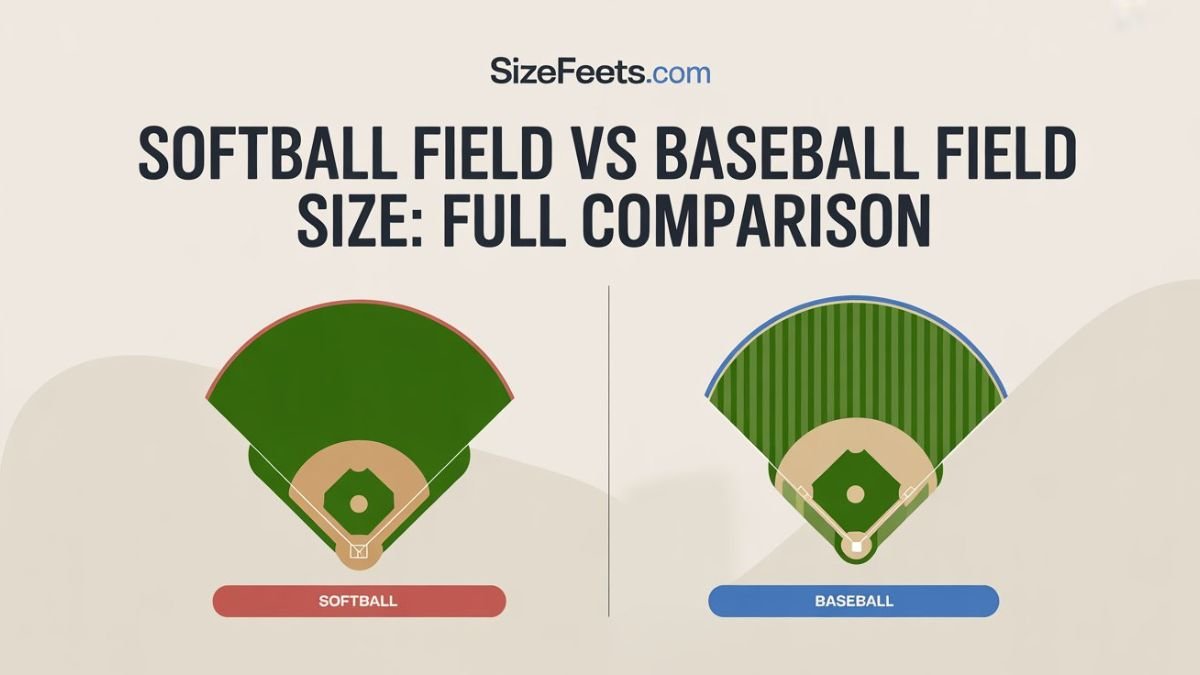
Softball Field vs Baseball Field Size: Full Comparison
Softball field vs baseball field size compares how big each field is. A baseball field is much larger. Baseball bases sit 90 feet apart. Softball bases sit 60 feet apart. Baseball outfields also reach much farther.
Have you ever wondered why the two games feel so different? The field size is a big reason. A baseball outfield can hit 400 feet. A softball outfield reaches only about 220 feet. Once you see the numbers, the gap is clear.
The two fields share a diamond shape but differ in size. Baseball pitches come from 60.5 feet away. Softball pitches come from just 43 feet. A softball is bigger than a baseball. These facts make softball field vs baseball field size easy to compare.
Softball Field vs Baseball Field Size in Different Units
The two fields share a diamond shape but differ a lot in size. In adult play, baseball uses 90-foot base paths and a 60-foot 6-inch pitching distance. Fastpitch softball uses 60-foot base paths and a 43-foot pitching distance. Here’s how the main measurements compare.
| Measurement | Baseball | Softball (Fastpitch) | Notes |
| Base paths | 90 ft | 60 ft | Distance between bases |
| Pitching distance | 60 ft 6 in | 43 ft | Rubber to home plate |
| Home to second (diagonal) | ~127 ft 3 in | ~84 ft 10 in | Across the diamond |
| Outfield (foul lines) | ~325 ft | ~200 ft | Down the lines |
| Outfield (center) | ~400 ft | ~220 ft | Deepest point |
| Pitching spot | Raised mound | Flat circle | Big rule difference |
These are standard adult dimensions. Youth leagues use shorter distances, and slowpitch softball sometimes uses 65-foot base paths. Rules vary slightly by league, so treat these as typical values for high school and college play.
Quick Reference Table
Want the fast version? This chart compares the two fields side by side and gives an everyday way to picture each measurement.
| Feature | Baseball | Softball | Visual / Notes |
| Base paths | 90 ft | 60 ft | Baseball is 1.5× longer |
| Pitching distance | 60.5 ft | 43 ft | Baseball is ~40% farther |
| Outfield down lines | ~325 ft | ~200 ft | About a football field longer |
| Center field | ~400 ft | ~220 ft | Baseball nearly double |
| Diamond diagonal | ~127 ft | ~85 ft | Home to second base |
| Ball circumference | ~9 in | ~12 in | Softball is bigger |
| Ball weight | ~5 oz | ~6.5–7 oz | Softball is heavier |
| Pitching style | Overhand, mound | Underhand, flat | Different motion |
| Bat max length | ~42 in | ~34 in | Baseball bats longer |
| Infield dirt | Larger | Smaller | Baseball has more |
12 Key Differences Between Softball and Baseball Fields
Base Paths: 90 Feet vs 60 Feet
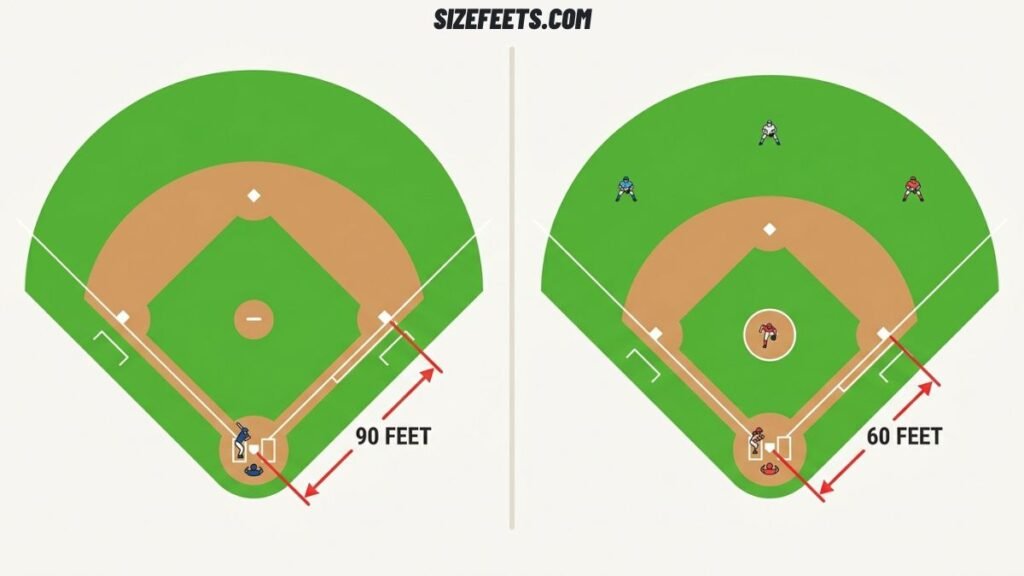
The biggest size difference is the base paths. Baseball bases are 90 feet apart, while fastpitch softball bases are 60 feet apart. That means a baseball diamond’s sides are half again as long as a softball diamond’s sides.
This gap shapes the whole game. On a baseball field, runners cover more ground, so speed and long throws matter more. On a softball field, the shorter 60-foot paths make plays faster and closer. Slowpitch softball sometimes uses 65-foot base paths, a bit longer than fastpitch. To picture the difference, a baseball base path is about the length of a bowling lane, while a softball path is roughly the length of a large truck.
Read Also: How Long Is 100 Inches? Size Guide With Real Comparisons
Pitching Distance: 60.5 Feet vs 43 Feet
The pitching distance also differs a lot. In baseball, the rubber sits 60 feet 6 inches from home plate. In fastpitch softball, it’s only 43 feet. So the softball pitcher stands much closer to the batter.
This closeness matters because softball pitches are thrown underhand but reach the plate fast due to the short distance. Baseball’s longer 60-foot-6 distance gives batters a split second more to react to overhand throws. Youth softball uses even shorter distances, like 35 or 40 feet. The 17-foot-6-inch gap between the two adult distances is about the length of a small car. That short difference changes the timing of the whole game.
Outfield Fences: 400 Feet vs 220 Feet
The outfield shows the clearest size gap. A baseball center field fence often sits about 400 feet from home plate, while a softball center fence is only about 220 feet. Down the foul lines, baseball reaches around 325 feet and softball around 200 feet.
This means a baseball outfield covers far more ground, so outfielders roam wide areas and home runs travel a long way. Softball’s shorter fences make the field more compact and the action tighter. The 180-foot difference in center field is more than half the length of a football field. To picture it, a baseball outfield could swallow a softball field whole with room to spare. It’s the single biggest size gap between the two.
The Diamond Diagonal: 127 Feet vs 85 Feet
The diagonal across the diamond, from home plate to second base, shows the infield size gap. On a baseball field, this distance is about 127 feet 3 inches. On a softball field, it’s about 84 feet 10 inches. That’s the throw a catcher makes to catch a runner stealing second.
The longer baseball diagonal means catchers need a stronger arm to throw out base stealers. The shorter softball diagonal makes those throws quicker and closer. This diagonal comes from the base path length: a 90-foot square gives 127 feet across, while a 60-foot square gives about 85 feet. To picture the difference, the baseball diagonal is about the length of a bowling lane and a half, while the softball one is roughly one lane.
The Ball: 9 Inches vs 12 Inches
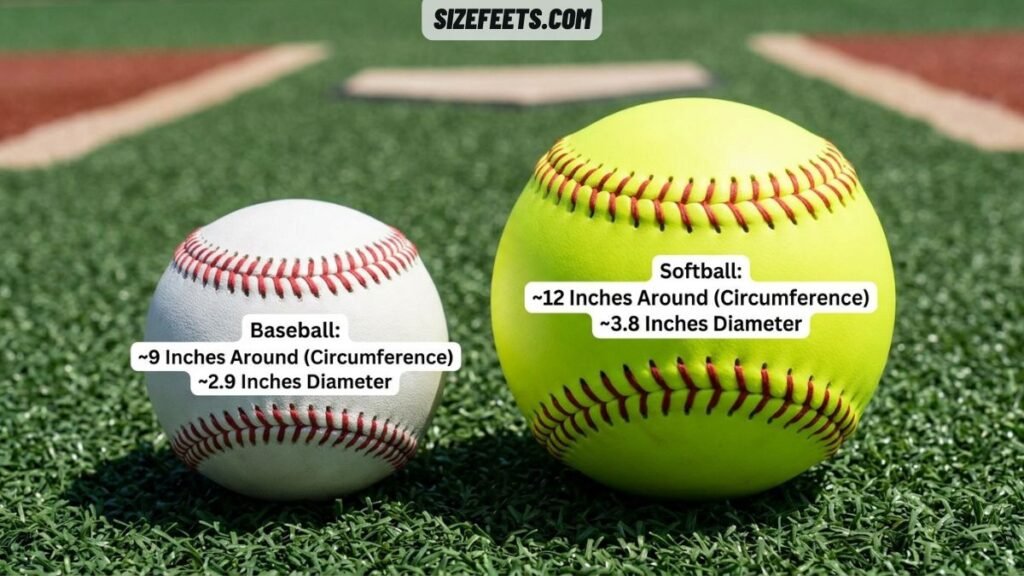
The balls differ as much as the fields. A baseball measures about 9 inches around with a diameter near 2.9 inches. A softball is bigger, at about 12 inches around with a diameter near 3.8 inches. Despite the name, a softball is not soft.
The larger softball is easier to see and hit but travels a shorter distance, which suits the smaller field. A baseball is smaller and denser, letting it fly farther on the bigger field. A baseball weighs about 5 ounces, while a softball weighs about 6.5 to 7 ounces. To picture the size gap, a baseball is close to a tennis ball’s width, while a softball is closer to a large grapefruit.
Read Also: Staircase Dimensions in Feet: Standard Sizes Explained
The Pitching Spot: Raised Mound vs Flat Circle
The pitching area is built differently. Baseball pitchers throw from a raised mound that stands about 10 inches above the field. Softball pitchers throw from a flat pitching circle level with the ground.
This is a key structural difference, not just a size one. The baseball mound gives pitchers a downhill angle to throw overhand with speed. The flat softball circle fits the underhand pitching motion, where the arm swings in a windmill. The circle is a marked 16-foot-wide flat area around the rubber. So beyond the distance gap, the shape of the pitching spot changes the whole throwing style. One is a small hill, and the other is flat ground.
Infield Dirt Area: Larger vs Smaller
The infield dirt area follows the base path size. A baseball infield, with 90-foot paths, has a much larger dirt area than a softball infield with 60-foot paths. Some softball fields have all-dirt infields, while baseball infields mix dirt and grass.
The bigger baseball infield gives fielders more ground to cover between bases. The smaller softball infield keeps plays tight and quick. On many softball fields, the entire infield is skinned dirt with no grass, which speeds up ground balls. Baseball usually keeps grass in the middle of the diamond. To picture it, a baseball infield covers about twice the area of a softball infield, matching the base path gap.
Bat Length: 42 Inches vs 34 Inches
The bats differ to match each game. Baseball bats can be up to about 42 inches long in the pros, while softball bats are capped at about 34 inches. Softball bats are shorter and often have a different barrel design.
The longer baseball bat suits the bigger field and overhand pitching, giving hitters more reach. The shorter softball bat fits the compact field and underhand pitches. Softball bats also come in fastpitch and slowpitch styles, tuned for each game’s speed. Both bats are made of wood, aluminum, or composite materials. To picture the gap, a baseball bat is about the length of a golf club, while a softball bat is closer to a yardstick.
Foul Territory: Larger vs Smaller
Foul territory is the area outside the foul lines. A baseball field has more foul territory than a softball field, thanks to its larger overall size. This is the space where fielders chase pop-ups behind the bases and along the lines.
More foul ground on a baseball field gives fielders extra room to catch foul balls, which can mean more outs. The smaller softball field has tighter foul territory, so foul balls more often land out of play. The size of this area depends on how the ballpark is built, so it varies from field to field. To picture it, baseball’s foul zones add a wide border around the diamond that softball fields keep much narrower.
The Batter’s Box Distance to the Pitcher
Because the pitching distances differ, the batter faces the pitcher from very different ranges. In baseball, the batter stands about 60 feet from the pitcher’s release. In softball, that drops to around 43 feet or less, since the pitcher is closer and strides forward.
This short range is why softball pitches reach the batter in a similar reaction time to baseball, even though they’re thrown underhand and slower in raw speed. The closer softball setup gives hitters about the same split second to swing. Baseball’s greater distance balances out its faster overhand throws. To picture the gap, the softball batter faces a pitcher about a car-length closer than a baseball batter does.
Total Field Area
Adding it all up, the two fields cover very different total areas. A baseball field spans several acres, with its deep outfield and wide foul ground. A softball field fits into a much smaller footprint because of its shorter base paths and closer fences.
A full baseball field can cover roughly 3 to 4 acres, while a softball field often fits in about 1 to 2 acres. This is why parks can fit more softball fields in the same space. The exact area depends on the outfield depth, which varies by ballpark. To picture it, you could fit two or more softball fields inside the space of one full baseball field, showing just how much bigger baseball is overall.
Base Size: Same Bases, Different Spacing
The bases themselves are close in size, but their spacing differs. Both sports use bases about 15 inches square, though some softball leagues use slightly larger bases. The big difference is how far apart they sit, not the bases themselves.
This means a runner on either field steps on a similar-size bag, but covers 90 feet in baseball and only 60 in softball to reach the next one. Some softball leagues use a double first base, a safety base split into white and colored halves, to prevent collisions. Home plate is the same 17 inches wide in both sports. So the bases match closely, while the distances between them set the two games apart.
How to Estimate Field Sizes Without a Tape Measure
No long tape handy? These simple tricks help you picture the difference between the two fields using things you already know.
Count in Steps
Your steps make a quick ruler. An adult step is about 2.5 feet. A baseball base path of 90 feet is about 36 steps, while a softball path of 60 feet is about 24 steps. Walk the two distances and count. The baseball path takes about 12 more steps than the softball path. This gives a hands-on feel for how much bigger a baseball diamond is, using nothing but your own stride.
Use a Football Field
A football field gives you a big known length. A football field is 300 feet long between goal lines, or 360 feet including end zones. A baseball center field at 400 feet is a bit longer than the full field with end zones. A softball center field at 220 feet is about two-thirds of the field. Picturing a football field helps you grasp the outfield sizes without measuring.
Compare the Balls in Hand
The balls show the difference up close. Hold a baseball and a softball side by side. The baseball is about the width of a tennis ball, while the softball is closer to a grapefruit. The softball is noticeably bigger and heavier. This quick, hands-on comparison shows how the equipment matches each field’s size, with the bigger ball fitting the smaller field.
Softball and Baseball Fields vs Other Fields
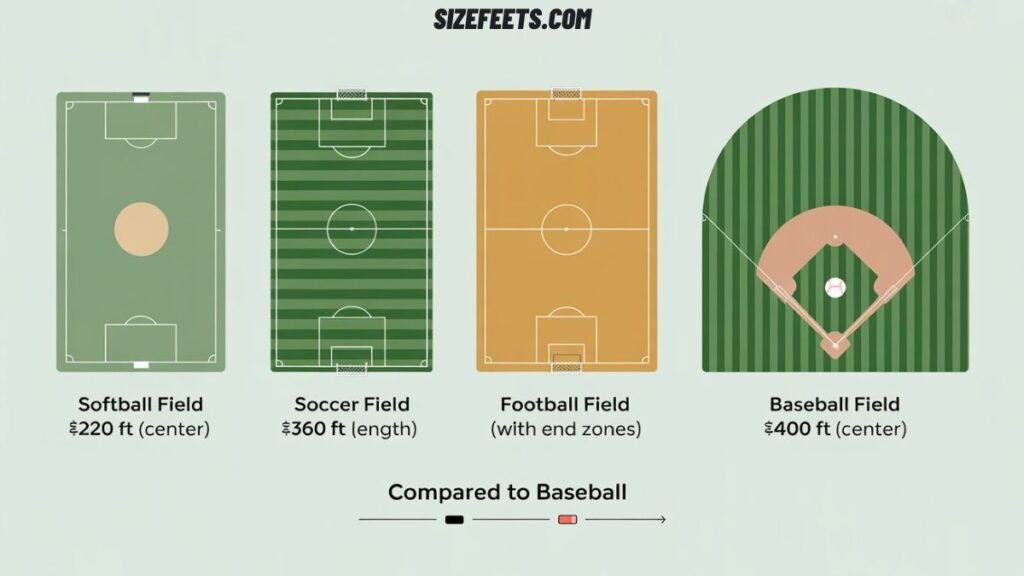
Seeing both fields next to other sports areas builds a clear picture. A baseball field is one of the largest sports areas, with outfields reaching 400 feet. A softball field is more compact, at about 220 feet. A soccer field is about 360 feet long, between the two. And a football field is 360 feet with end zones. So a baseball field is among the biggest playing areas, while a softball field is closer in size to a football or soccer field.
| Field | Longest Dimension | Compared to Baseball |
| Softball field | ~220 ft (center) | About half |
| Soccer field | ~360 ft (length) | A bit shorter |
| Football field | ~360 ft (with end zones) | A bit shorter |
| Baseball field | ~400 ft (center) | The base field |
| Baseball (foul territory) | Varies, large | Adds even more area |
Frequently Asked Questions
Is a baseball or softball field bigger?
A baseball field is bigger. Baseball bases sit 90 feet apart and outfields reach about 400 feet, while softball uses 60-foot bases and about 220-foot outfields.
What is 70 mph in softball equal to in baseball?
Because a softball is pitched from just 43 feet, a 70 mph softball pitch gives about the same reaction time as a low-90s mph baseball pitch.
What is a 90 mph baseball pitch compared to softball?
A 90 mph baseball pitch from 60.5 feet gives similar reaction time to a roughly 68 to 70 mph softball pitch thrown from 43 feet.
How fast do girls pitch in softball?
Elite college and pro softball pitchers often throw 60 to 70 mph. High school pitchers usually range from about 50 to 62 mph.
Is a 110 mph fastball possible?
No pitcher has officially thrown 110 mph. The fastest recorded MLB pitch is about 105 mph, so 110 mph remains beyond current human limits.
What size is a softball vs baseball diamond?
A softball diamond has 60-foot sides, giving a home-to-second diagonal of about 85 feet. A baseball diamond has 90-foot sides, giving a diagonal of about 127 feet. So the baseball diamond is significantly larger, covering roughly twice the infield area of a softball diamond.
Conclusion
Now you know the softball field vs baseball field size and how they compare. A baseball field is much larger. Baseball bases sit 90 feet apart, while softball bases sit 60 feet. Baseball pitches come from 60.5 feet, and softball pitches come from 43 feet. outfields reach about 400 feet, while softball outfields reach about 220 feet. These few numbers cover almost everything you need to know.
You can also picture the gap with simple comparisons. A baseball outfield runs nearly a football field longer than a softball one. A baseball infield covers about twice the softball infield area. A softball uses a bigger ball to fit its smaller field. With these facts in mind, you can picture the softball field vs baseball field size anytime.
Related Guides:
1: Badminton Court Size in Meter: Full Dimensions Explained
2: Average Living Room Size: Typical Dimensions Explained
3: Garage Door Sizes Chart: Every Standard Dimension Explained (2026)
4: Slim Jim Trash Can Sizes: Every Dimension Explained (2026)




2 Comments