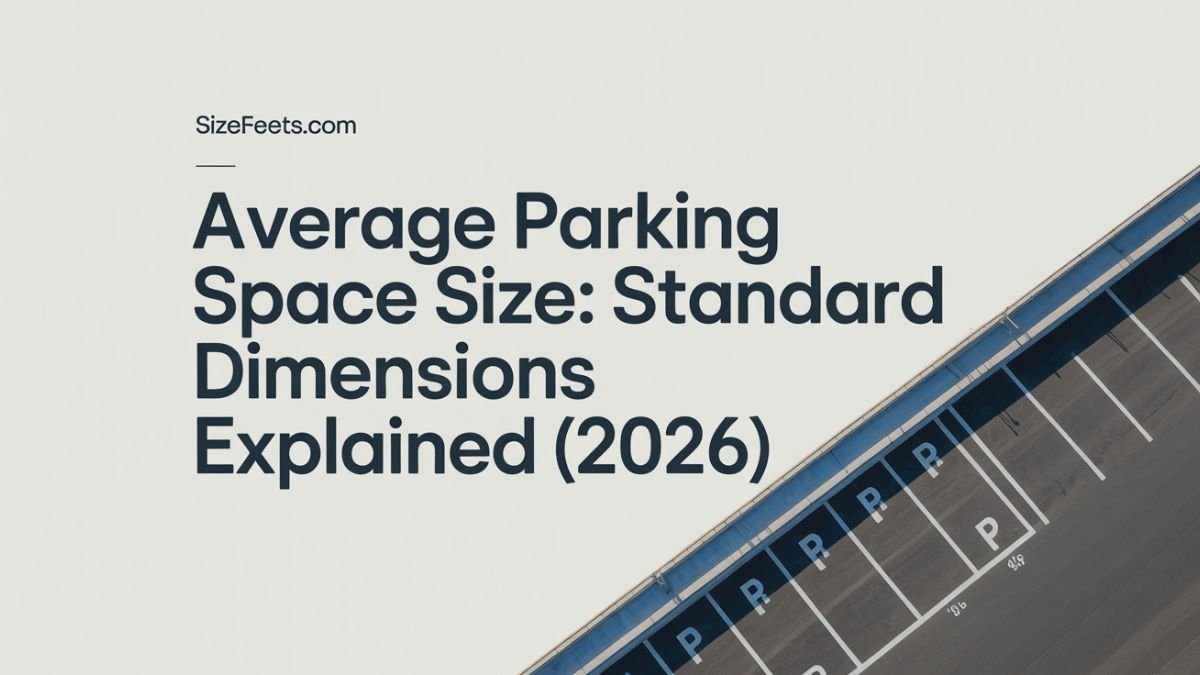
Average Parking Space Size: Standard Dimensions Explained (2026)
Average parking space size describes how big a standard spot is. A common space is about 9 feet wide. It is about 18 feet long. That gives around 162 square feet. This is the standard size in most lots.
Have you ever squeezed into a spot that felt too tight? The width is often the reason. A standard space fits most cars well. A compact space is smaller. Once you know the sizes, parking makes more sense.
Sizes change by city and lot type. Widths run from 8.5 to 9 feet. Lengths run from 18 to 20 feet. Accessible spaces are wider than standard ones. These facts make average parking space size easy to picture.
Average Parking Space Size in Different Units
A standard parking space is a simple rectangle. It measures about 9 feet (2.7 m) wide and 18 feet (5.5 m) long, giving around 162 square feet (15 square meters). Widths range from 8.5 to 9 feet, and lengths from 18 to 20 feet. Here’s the breakdown.
| Measurement | Feet | Meters | Notes |
| Width (standard) | 9 ft | 2.7 m | Side to side |
| Length (standard) | 18 ft | 5.5 m | Front to back |
| Area | ~162 sq ft | ~15 sq m | Total space |
| Width (compact) | 8 ft | 2.4 m | Small cars |
| Width (accessible) | 11–16 ft | 3.4–4.9 m | With access aisle |
| Aisle width | 24 ft | 7.3 m | Two-way drive lane |
These are common values, since sizes vary by city and lot type. Treat them as close approximates. Standard spaces are about 9 by 18 feet, but some lots use 8.5-foot widths to fit more cars, while others go wider for comfort.
Quick Reference Table
Want the fast version? This chart shows common parking space sizes and how to picture each one. All figures are approximate and vary by lot.
| Space Type | Size (ft) | Visual / Notes | Best For |
| Standard | 9 × 18 | About 3.5 cars wide | Most lots |
| Compact | 8 × 16 | Smaller cars | Tight lots |
| Accessible | 11–16 × 18 | Extra side room | ADA spaces |
| Width only | 9 ft | About 1.5 doors | Side-to-side |
| Length only | 18 ft | About a mid-size car | Front-to-back |
| Parallel space | 8 × 22 | Longer for entry | Street parking |
| Area | ~162 sq ft | A small bedroom | Floor space |
| Two spaces | 18 × 18 | A two-car garage | Comparison |
14 Everyday Things That Match a Parking Space Size
Here are 14 objects and spaces that help you picture the average parking space size without a tape measure. Some match the width, some the length, and a few show the whole space.
A Mid-Size Car (Length)
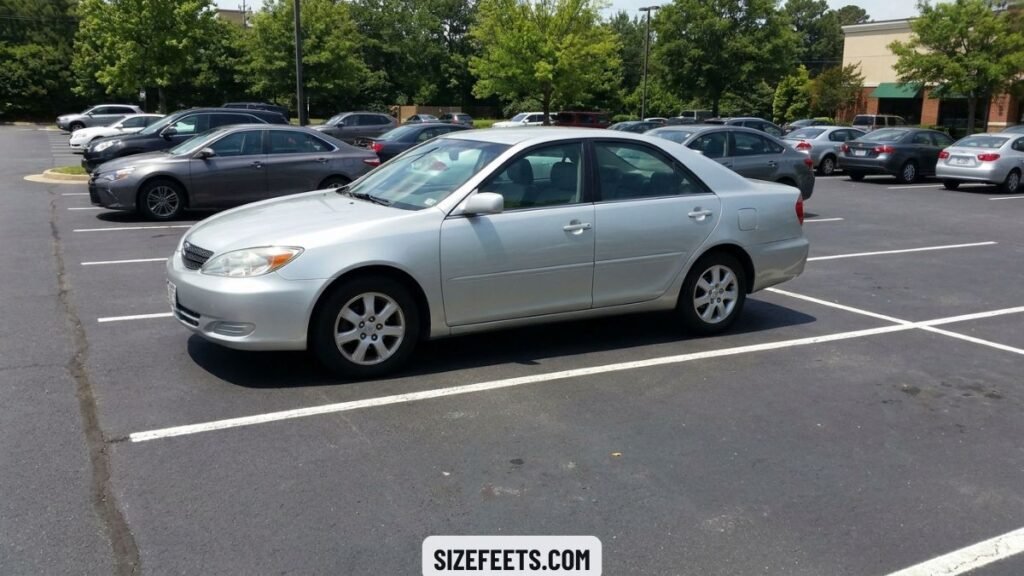
A mid-size car is close to a parking space’s length. A typical car is about 15 to 16 feet long, so a standard 18-foot space leaves a couple of feet to spare. Picture a car parked with a little room front and back.
Parking spaces are sized so a car fits with room to open doors and pull in. The 18-foot length holds most cars, with SUVs and trucks filling more of it. Because a car is a familiar object, it’s the most natural way to picture the length. If you imagine a mid-size sedan in a spot, you can see how the 18-foot length gives it a bit of breathing room on each end.
Read Also: Wheelchair Size Chart: Standard Widths and Dimensions (2026)
One and a Half Doors (Width)
A standard door helps you picture the space width. An interior door is about 32 inches (2.7 feet) wide, so a 9-foot parking space is close to three and a third doors side by side. Picture a row of doors to see the width.
Doors are a familiar width, found in every home. A parking space’s 9-foot width is about three standard doorways across. Because you walk through doors daily, they make a handy comparison. If you imagine three door-widths lined up, plus a little, you’ve got the width of a parking space. It’s an easy way to picture how wide a spot is using something you know well from your house.
A Small Bedroom (Total Area)
A small bedroom is close to a parking space’s total area. A parking space is about 162 square feet, and a small bedroom is around 120 to 160 square feet, so they’re close. Picture a small bedroom’s floor to see the space.
The 162-square-foot area comes from multiplying the 9-foot width by the 18-foot length. A small bedroom covers about the same floor space. Because a bedroom is a familiar size, it helps you picture the area. If you imagine a small bedroom’s floor cleared out, that’s about the size of one parking space. It’s an easy way to grasp how much ground a single spot takes up in a lot.
A Two-Car Garage (Two Spaces)
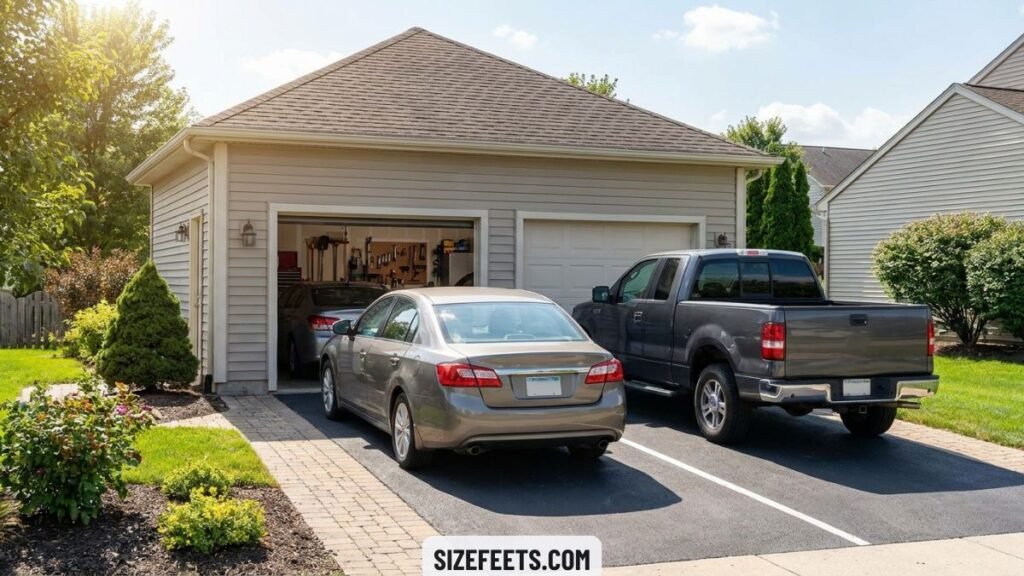
A two-car garage is close to two parking spaces. A double garage is about 18 by 20 feet, or 360 square feet, close to two 9-by-18-foot spaces side by side. Picture a double garage to see two spots.
Two parking spaces together cover about 324 square feet, near a two-car garage’s floor. Because a garage is a familiar space, it makes a good comparison. Two spaces side by side are a bit smaller than a double garage, which adds room to walk around the cars. If you picture your garage, you can imagine two parking spaces filling most of it. It’s an easy way to grasp the size of a pair of spots.
Read Also: Garage Door Sizes Chart: Every Standard Dimension Explained (2026)
Three Bicycles End to End (Length)
Three bikes in a row help you picture the space length. A standard bicycle is about 5.5 to 6 feet long, so three end to end reach about 18 feet, matching a parking space. Picture three bikes lined up to see the length.
Bikes are a familiar size, and lining them up gives a clear length reference. Three bicycles nose to tail come close to a parking space’s 18-foot length. Because bikes are common, this is an easy comparison. If you imagine three bikes parked in a line, you’ve got the length of a standard parking spot. It’s a fun way to picture the front-to-back size using something many people own.
A Queen Mattress Plus a Bit (Width)
A queen mattress helps you picture the space width. queen bed is 5 feet (60 inches) wide, so a 9-foot parking space is close to the mattress plus about 4 feet. Picture a queen bed with extra room added to the side.
Queen mattresses are a common size, familiar in most bedrooms. A parking space is wider than a queen bed by about 4 feet. Because a bed is easy to picture, it makes a handy comparison. If you imagine a queen mattress with about four more feet added to its width, you’ve got the width of a parking space. It’s an easy way to picture the side-to-side size using furniture from your bedroom.
A King Mattress (Width Comparison)
A king mattress helps you picture the space width from a closer size. king bed is 76 inches (6.3 feet) wide, so a 9-foot parking space is the mattress plus about 2.7 feet. Picture a king bed with a bit more width added.
King mattresses are the widest standard bed, so they’re closer to a parking space’s width than a queen. A spot is about 2.7 feet wider than a king bed. Because a king bed is a familiar large object, it makes a good comparison. If you imagine a king mattress with a few more feet added to the side, you’ve got the width of a parking space. It’s an easy bedroom-based reference for the width.
A Ping-Pong Table Plus a Bit (Length)
A ping-pong table helps you picture the space length. A table tennis table is 9 feet long, so a parking space at 18 feet is about two tables end to end. Picture two ping-pong tables in a row to see the length.
Ping-pong tables are a standard 9 feet long, a familiar size in game rooms. Two of them end to end match a parking space’s 18-foot length. Because the table is a set size, it makes a handy comparison. If you imagine two ping-pong tables lined up, you’ve got the length of a parking spot. Interestingly, one table’s length also matches a parking space’s 9-foot width, making it a doubly useful reference.
A Sofa Times 2.5 (Length)
A standard sofa helps you picture the space length. A three-seat sofa is about 7 feet long, so a parking space at 18 feet is about two and a half sofas end to end. Picture a couple of couches lined up to see the length.
Sofas are a familiar piece of furniture, common in living rooms. About two and a half sofas end to end match a parking space’s 18-foot length. Because a sofa is a known size, it makes a handy comparison. If you imagine two and a half couches in a row, you’ve got the length of a parking spot. It’s an easy way to picture the front-to-back size using living room furniture you know well.
A Refrigerator Times 3 (Width)
A refrigerator helps you picture the space width. A standard fridge is about 3 feet wide, so a 9-foot parking space is close to three fridges side by side. Picture three refrigerators in a row to see the width.
Refrigerators are a familiar appliance, close to 3 feet wide. Three of them side by side match a parking space’s 9-foot width. Because a fridge is a known size, it makes a handy comparison. If you imagine three refrigerators lined up, you’ve got the width of a parking spot. It’s an easy way to picture the side-to-side size using a common kitchen appliance found in nearly every home.
A Golf Cart (Size Comparison)
A golf cart helps you picture how a small vehicle fits a space. golf cart is about 4 feet wide and 8 feet long, so it takes up less than half a parking space. Picture a golf cart with lots of room around it in a spot.
Golf carts are small vehicles used on courses and in communities. One fits easily inside a parking space with room to spare. Because a golf cart is a familiar size, it shows how much space a spot really offers. If you imagine a golf cart parked in a standard spot, the extra room around it helps you see how big a full parking space is compared to a small vehicle.
A Pickup Truck (Length)
A pickup truck helps you picture the space length. A full-size pickup is about 19 to 20 feet long, so it fills or slightly overhangs a standard 18-foot space. Picture a truck parked snugly in a spot.
Pickups are among the longest common vehicles, so they use most or all of a parking space. This shows why some lots use longer 20-foot spaces. Because a truck is a familiar large vehicle, it makes a good comparison. If you imagine a full-size pickup in a standard spot, it fills the length with little to spare. It’s an easy way to see the front-to-back limit of a parking space.
Two Doors Laid Flat (Length)
Two doors laid end to end help you picture the space length. A standard door is 80 inches (6.7 feet) tall, so about two and a half doors laid flat reach 18 feet. Picture doors lying in a line to see the length.
Doors are a familiar 80-inch length, found in every home. About two and a half of them laid end to end match a parking space’s 18-foot length. Because doors are a known size, they make a handy comparison. If you imagine a few doorways lying flat in a row, you’ve got the length of a parking spot. It’s an easy way to picture the front-to-back size using something from your house.
A Standard Kitchen Table (Width)
A kitchen table helps you picture part of the space width. A dining table is about 3 to 4 feet wide, so a 9-foot parking space is close to two and a half tables side by side. Picture a couple of tables in a row to see the width.
Kitchen tables are a familiar piece of furniture, common in most homes. About two and a half of them side by side match a parking space’s 9-foot width. Because a table is a known size, it makes a handy comparison. If you imagine two and a half dining tables lined up, you’ve got the width of a parking spot. It’s an easy way to picture the side-to-side size using furniture from your kitchen.
How to Measure a Parking Space Without a Tape Measure
No tape handy? These simple tricks help you estimate a parking space’s size using things you already know.
Use Your Steps
Your steps make a quick ruler. An adult step is about 2.5 feet. To measure the 9-foot width, walk about 4 steps across the space. For the 18-foot length, walk about 7 steps front to back. Count carefully and keep your steps even. This won’t be exact, but it gets you close enough to check a space or lay out a rough spot before fine-tuning with a proper measure.
Use a Car as a Guide
A car gives you a known size. A mid-size car is about 15 feet long and 6 feet wide. Park one in the space, and the extra room around it shows the spot’s size. A standard 18-foot space leaves about 3 feet of length beyond the car, and a 9-foot width leaves about 3 feet across. This is a quick way to gauge a space using a vehicle you already have.
Count Floor Lines or Tiles
Painted lines and tiles help in some lots. Many parking lots have markings, so you can measure between the painted lines directly. In garages with tiled or scored concrete, count the sections, which are often 1 or 2 feet each. Counting these gives you the width and length with no tape. It’s a handy way to check a space using the markings already there in the lot or garage.
Average Parking Space Size vs. Other Spaces
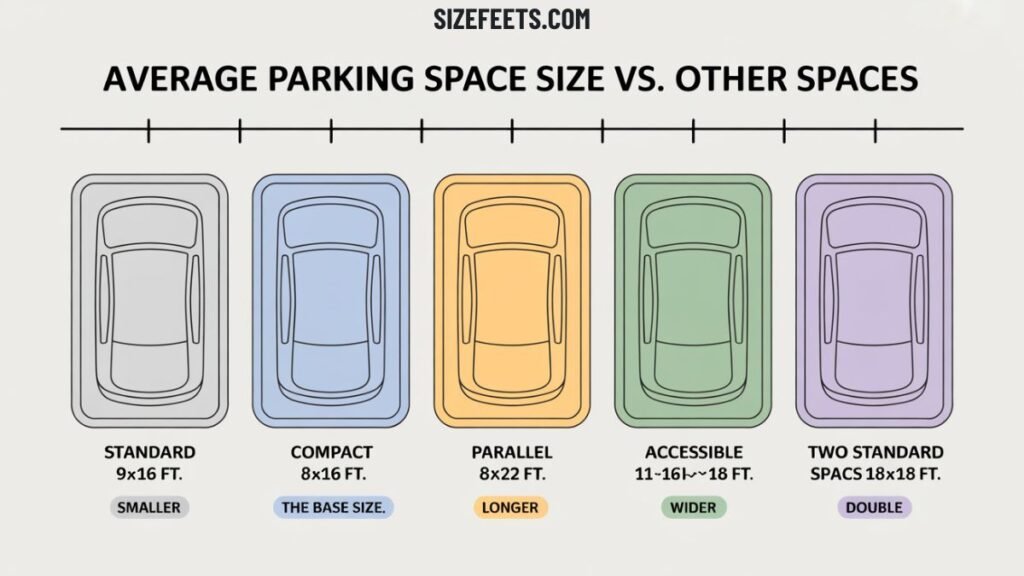
Seeing the parking space next to other sizes builds a clear picture. A standard parking space is 9 by 18 feet. A compact space is smaller at about 8 by 16 feet. An accessible space is wider, at 11 to 16 feet including the access aisle. And a parallel space is longer, about 8 by 22 feet, for easier entry. So a standard space sits in the middle, with compact spaces tighter and accessible or parallel spaces larger.
| Space Type | Size (ft) | Compared to Standard |
| Compact | 8 × 16 | Smaller |
| Standard | 9 × 18 | The base size |
| Parallel | 8 × 22 | Longer |
| Accessible | 11–16 × 18 | Wider |
| Two standard spaces | 18 × 18 | Double |
Frequently Asked Questions
What is the standard size of a parking space?
A standard parking space is about 9 feet wide and 18 feet long, or 2.7 by 5.5 meters. That gives around 162 square feet of space.
How wide is a standard parking space?
A standard parking space is about 9 feet wide, though some lots use 8.5 feet to fit more cars. This width lets drivers open their doors and pull in comfortably. Accessible spaces are wider, at 11 to 16 feet including the access aisle for wheelchairs.
How long is a parking space?
A standard parking space is about 18 feet long, though some lots use 20 feet for larger vehicles. This length holds most cars with a little room to spare. Full-size pickup trucks and SUVs, at 19 to 20 feet, may fill or slightly overhang a standard 18-foot space.
How many square feet is a parking space?
A standard parking space is about 162 square feet, based on a 9-by-18-foot size. Larger spaces of 9 by 20 feet reach 180 square feet. With drive aisles added, each space needs about 300 to 350 square feet total in a parking lot.
What is the size of a compact parking space?
A compact parking space is about 8 feet wide and 16 feet long, smaller than a standard space. These are made for smaller cars, helping lots fit more vehicles. Compact spaces are common in cities and garages where space is tight and every spot counts.
How big is a handicap parking space?
An accessible parking space is about 8 feet wide, plus an access aisle of 5 to 8 feet, giving a total width of 11 to 16 feet. The extra room lets wheelchair users get in and out. Van-accessible spaces have the widest aisles for lifts and ramps.
How wide is a parking space in meters?
A standard parking space is about 2.7 meters wide and 5.5 meters long. Widths range from 2.4 to 2.7 meters, and lengths from 5.5 to 6 meters. To convert, one foot equals about 0.3 meters, so 9 feet is roughly 2.7 meters.
What size is a parallel parking space?
A parallel parking space is about 8 feet wide and 22 feet long. The extra length gives room to pull in and out along the curb. Parallel spaces are common on streets, where cars park in a line rather than side by side, needing more front-to-back room.
Conclusion
Now you know the average parking space size and how to picture it with ease. A standard space is about 9 feet wide. It is about 18 feet long. That gives around 162 square feet, or 15 square meters. Compact spaces run smaller, and accessible spaces run wider. These few numbers cover almost everything you need to know.
You can also picture the space with simple comparisons. A standard spot is close to a small bedroom’s floor. It runs a bit longer than a mid-size car. It stretches about three doors wide. Keep these easy comparisons in mind whenever you park or plan a lot. With this knowledge, you can picture the average parking space size anytime.
1: Staircase Dimensions in Feet: Standard Sizes Explained
2: Average Living Room Size: Typical Dimensions Explained
3: How Many Square Feet Is a Basketball Court? Full Breakdown
4: Softball Field vs Baseball Field Size: Full Comparison