
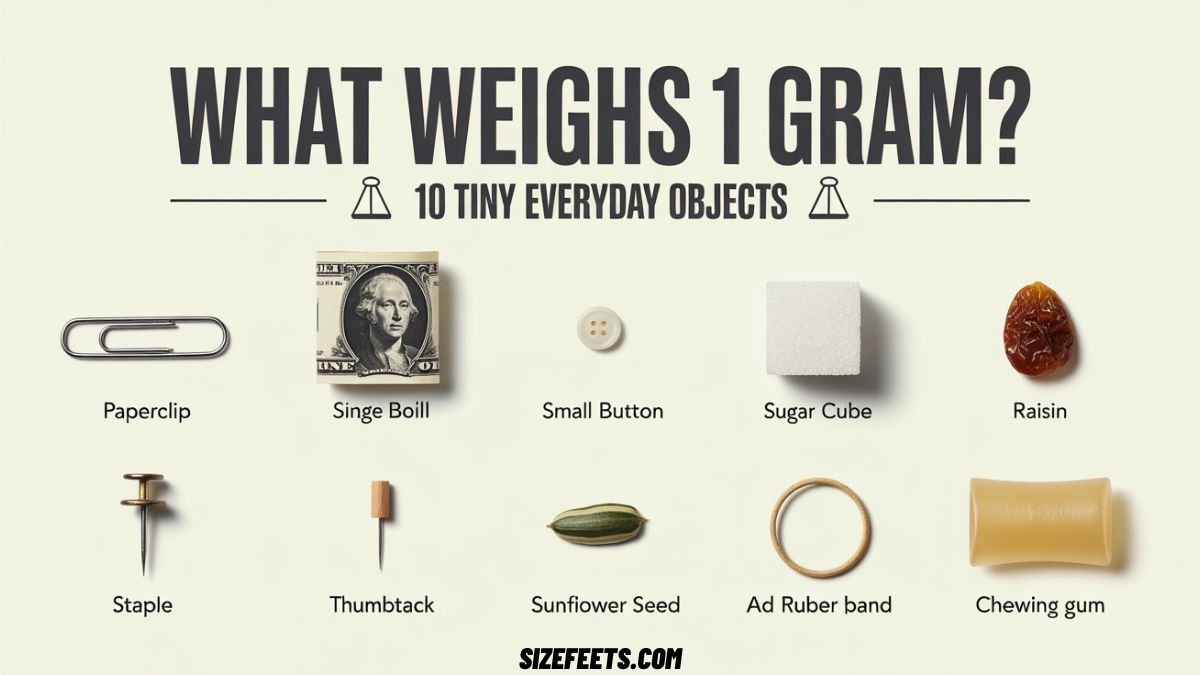
What Weighs 1 Gram? 10 Tiny Everyday Objects
What weighs 1 gram is a common way to picture a tiny weight. 1 gram equals about 0.035 ounces. That is one-thousandth of a kilogram. Many small objects hit this weight. A small paperclip weighs about 1 gram, and so does 1 mL of water.
Have you ever needed to weigh something with no scale nearby? You can still get very close. A US dollar bill weighs about 1 gram. A single raisin does too. Once you learn a few of these, you can guess the weight anytime.
Lots of tiny items land near 1 gram. A thumbtack weighs about this much. A stick of gum comes close as well. A pinch of salt works too. These simple objects make 1 gram easy to picture without any tools.
What Weighs 1 Gram in Different Units
Let’s start with the numbers. 1 gram equals about 0.035 ounces, or roughly 0.0022 pounds. In metric terms, that’s 0.001 kilograms. Here’s how 1 gram converts across the units people search for most.
| Unit | Equivalent | Notes |
| Grams | 1 g | The base figure |
| Ounces | ~0.035 oz | A tiny fraction of an ounce |
| Pounds | ~0.0022 lb | Very light in imperial |
| Kilograms | 0.001 kg | One-thousandth of a kilo |
| Milligrams | 1,000 mg | 1 g = 1,000 mg |
| Carats | 5 carats | 1 carat = 0.2 g, used for gems |
| Water volume | 1 mL | Water weighs 1 g per mL |
Because water weighs one gram per milliliter, 1 gram of water is the same as 1 mL. That trick makes 1 gram easy to picture in the kitchen.
Quick Reference Table
Want the fast version? These tiny items weigh close to 1 gram. The table is honest about which ones are exact and which are just close.
| Item | Exact or Approx. | Visual / Notes | Best For |
| A small paperclip | Approx. | ~1 g each | A classic tiny weight |
| 1 mL of water | Exact | 1 g per mL | Kitchen math |
| A US dollar bill | Approx. | ~1 g each | A pocket cue |
| A raisin | Approx. | ~0.5–1 g | Small food weight |
| A thumbtack | Approx. | ~1 g | Desk-drawer item |
| A stick of gum | Approx. | ~1.5 g | A touch heavy |
| A sugar packet (part) | Approx. | ~4 g full packet | A quarter packet ≈ 1 g |
| A paper staple | Approx. | ~0.03 g each | Many staples per gram |
| A pinch of salt | Approx. | ~1 g | Kitchen pinch |
| A birthday candle | Approx. | ~1 g | Party-supply item |
Everyday Things That Weigh 1 Gram
Here are 10 objects that weigh about 1 gram. A couple land on the number closely, and the rest sit near enough to help you picture the weight.
A Small Paperclip
Read Also : How Much Is 10 Grams? 10 Everyday Objects That Weigh It
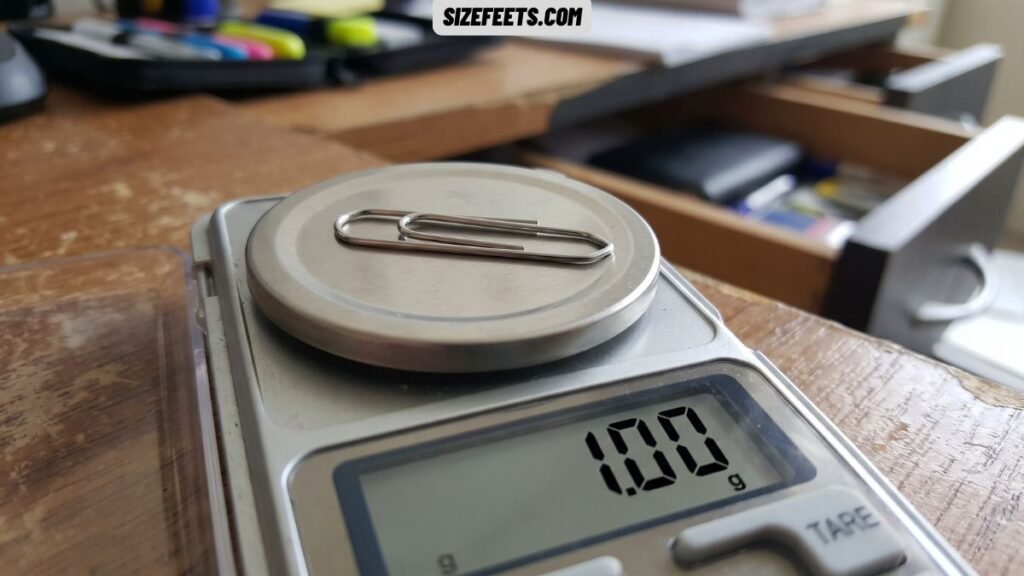
A standard small paperclip is the classic answer to what weighs 1 gram. A regular-size paperclip weighs about 1 gram, which is why it’s used so often as a reference. Pick one up and you’ll barely feel it in your hand.
Paperclips are made from thin steel wire bent into a looping shape. The most common design is called the “Gem” clip, and it has looked much the same for over a hundred years. Larger jumbo clips weigh more, closer to 1.5 grams, so use the standard small size for the best match. Since paperclips sit in nearly every desk drawer, one makes an easy and reliable 1-gram reference.
1 mL of Water
Water gives you an exact match every time. Because water weighs 1 gram per milliliter, a single 1 mL of water weighs exactly 1 gram. Use a small dropper or measuring spoon to see this for yourself.
This works thanks to water’s density, which stays close to 1 g/mL at normal room temperature. The rule is handy when a recipe or science task lists grams but you only have a way to measure liquid. One mL is also about a fifth of a teaspoon, a very small amount. Just remember that other liquids, like oil or milk, weigh slightly more or less than plain water.
A US Dollar Bill
Read Also : Coke Can Size (2026): How Big Is a Standard Can, Really?
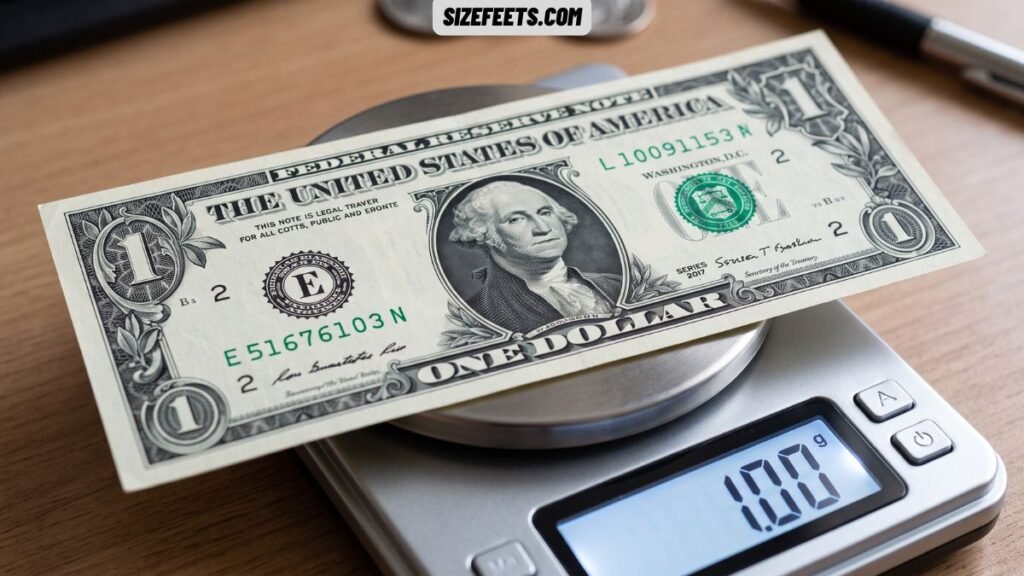
A single US dollar bill weighs almost exactly 1 gram. Every US bill weighs about 1 gram, no matter the value, so a $1, $5, or $20 note all weigh the same. Hold one flat and you’re holding roughly a gram.
US bills are made of a blend of cotton and linen, not regular paper, which is why they feel tough and last so long. This uniform weight means you can count large stacks of cash by weighing them. Banks and the mint use this trick to check big piles of money quickly. Since most people carry a bill, it’s one of the easiest 1-gram references around.
A Raisin
A single raisin weighs close to 1 gram. An average raisin weighs about 0.5 to 1 gram, so a plump one lands right near the mark. Drop one in your palm to feel just how light a gram can be.
Raisins are dried grapes, which is why they’re small and wrinkled but still a bit heavy for their size. They hold natural sugar and a little water, giving them quick energy. Their weight changes with size and how dry they are, so treat a raisin as an approximate cue. Still, if you have a box in the pantry, one raisin is a fun way to picture 1 gram of food.
A Thumbtack
A metal thumbtack weighs about 1 gram. A standard push pin or thumbtack weighs close to 1 gram, making it a handy office reference. Hold one and you’ll feel almost nothing, which is what a gram feels like.
Thumbtacks have a flat metal or plastic head and a short, sharp steel point. They’re used to pin notes and photos to cork boards and walls. Plastic-topped push pins can weigh a bit more than all-metal tacks, so pick a small metal one for the closest match. Since a box of tacks sits in most homes and offices, a single thumbtack works well as a 1-gram guide.
A Stick of Gum
A single stick of chewing gum weighs close to 1 gram. A thin stick of gum weighs about 1 to 1.5 grams, so it’s a touch heavy but still a good, familiar match. Unwrap one and feel how light it is.
Gum is made from a chewy base mixed with sweeteners and flavoring. Stick gum is thin and flat, which keeps each piece very light. Chunkier pieces or coated gum pellets weigh a little more, so stick with the classic flat kind for the best match. Since a pack of gum fits in any pocket or bag, one stick makes an easy, on-the-go reference for about 1 gram.
A Pinch of Salt
A pinch of table salt weighs about 1 gram. A small pinch you grab between your finger and thumb comes to roughly 1 gram, give or take. Sprinkle one into your palm to see a gram of salt.
Salt is dense, so even a tiny pinch adds up in weight faster than lighter powders. Cooks add pinches of salt to bring out flavor in food. The exact weight of a pinch changes from person to person, since everyone’s fingers grab a different amount, so it’s an approximate cue at best. Still, for a quick kitchen picture of 1 gram, a pinch of salt does the trick.
A Birthday Candle
A thin birthday candle weighs about 1 gram. The small candles you stick in a cake weigh roughly 1 gram each, making them a fun party-supply reference. Hold one and it feels almost weightless.
Birthday candles are made of wax with a thin cotton wick down the middle. They come in packs of many colors and are made to burn for just a minute or two. Bigger novelty or number-shaped candles weigh more, so use the classic thin ones for the closest match. If you have a pack in the kitchen drawer, one candle gives you a light and easy 1-gram reference.
A Quarter of a Sugar Packet
About a quarter of a sugar packet weighs 1 gram. A full sugar packet holds around 4 grams of sugar, so pouring out roughly one-fourth gives you close to 1 gram. It’s an easy way to picture a gram of food.
Sugar packets are the small paper sachets found at cafes and diners next to the coffee. Each one holds a set amount, which is why they’re handy for rough measuring. The sugar inside is made of fine crystals that pour easily. Since packets are free at most coffee shops, splitting one into quarters is a simple, no-cost way to see what 1 gram looks like.
A Plastic Bottle Cap
A small plastic bottle cap weighs close to 1 gram. The cap from a water or soda bottle weighs about 1 to 2 grams, so a lightweight one lands near the mark. Twist one off and hold it to feel a weight near a gram.
Bottle caps are made of hard plastic molded to seal tightly and keep drinks fresh. Their small size and thin walls keep them very light. Metal caps from glass bottles weigh more, so stick with the plastic screw-on kind for the best match. Since almost every drink comes with one, a plastic bottle cap is an easy, throwaway object to picture around 1 gram.
How to Measure 1 Gram Without a Scale
No scale in the house? These simple methods let you get close to 1 gram using things you already own.
Use a Paperclip
A small paperclip is a ready-made 1-gram weight. Since a standard clip weighs about 1 gram, you can use one to build a simple balance. Rest a ruler on a round pencil so it tips like a seesaw. Place a paperclip on one side, then add your item to the other side until it levels out. When both sides balance, your item weighs about 1 gram. It’s rough, but it works with no scale at all.
Pour Out 1 mL of Water
A dropper or small spoon turns water into a weight. Since water weighs 1 gram per milliliter, 1 mL of water weighs exactly 1 gram. Fill a medicine dropper or the tip of a measuring spoon to the 1 mL line. This works because of water’s density at room temperature. It’s the fastest kitchen method when a recipe or project calls for a single gram and you don’t own a scale.
Split a Sugar Packet
A sugar packet gives you a food-based guide. Each packet holds about 4 grams of sugar, so pouring out one-quarter equals close to 1 gram. Tear the top and tip out roughly a fourth of the contents onto a spoon. This method is handy at cafes or diners where packets are free. It’s not exact, but it gives you a quick, real-world picture of what a single gram of sugar looks like.
What Weighs 1 Gram vs. Other Common Weights
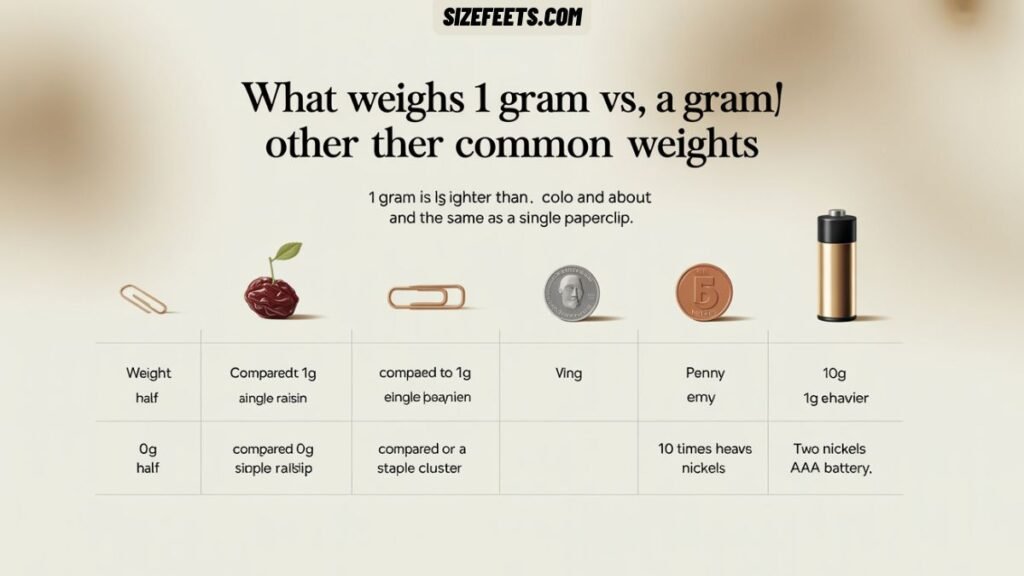
Seeing 1 gram next to nearby weights helps it click. 0.5 grams is half of this, about the weight of a single raisin or a small staple cluster. 2 grams is double, close to two paperclips or a US penny, which weighs about 2.5 grams. 5 grams is five times heavier, roughly the weight of one US nickel. And 10 grams is ten times more, about two nickels or a AAA battery. So 1 gram is one of the lightest weights you’ll handle, lighter than a coin and about the same as a single paperclip.
| Weight | Compared to 1 g | Everyday Example |
| 0.5 g | Half | A single raisin or a small staple cluster |
| 1 g | The base weight | A small paperclip or a dollar bill |
| 2 g | Double | Two paperclips (a penny is ~2.5 g) |
| 5 g | 5 times heavier | One US nickel |
| 10 g | 10 times heavier | Two nickels or a AAA battery |
Frequently Asked Questions
What common things weigh 1 gram?
A small paperclip, a thumbtack, a US dollar bill, and a stick of gum each weigh about 1 gram. A single raisin is close too.
What weighs exactly 1 gram?
1 mL of water weighs exactly 1 gram, since water weighs 1 gram per milliliter. A US dollar bill is very close at about 1 gram.
How do I measure 1 gram without a scale?
Use a small paperclip, which weighs about 1 gram, or pour out 1 mL of water. You can also split a sugar packet into quarters.
What does 1 gram look like?
1 gram looks like a single paperclip, a raisin, or a pinch of salt. It is a tiny, light amount you can barely feel in your hand.
Is 1 gram equal to 1 spoon?
No, one spoon holds much more than 1 gram for most foods. A teaspoon of water is about 5 grams, so 1 gram is roughly a fifth of a teaspoon.
What weighs 1 gram in coins?
No single US coin weighs exactly 1 gram, since the lightest, the penny, weighs 2.5 grams. A US dollar bill is a better match at about 1 gram. For coins, half a penny’s weight would be closest, but a paperclip or bill is far easier to use.
Conclusion
Now you know what weighs 1 gram and how to picture it with ease. 1 gram equals about 0.035 ounces, or one-thousandth of a kilogram. A US dollar bill weighs about 1 gram. 1 mL of water weighs exactly 1 gram too. These make simple reference weights that you can trust without any tool. You can even use them to build a quick balance scale at home.
Many tiny objects also help you feel 1 gram. A small paperclip matches this weight almost exactly. A single raisin and a thumbtack come close as well. Keep these simple items in mind whenever you need a quick guide. With this knowledge, you can estimate what weighs 1 gram anytime, even without a scale nearby.






3 Comments