

Standard Magazine Size : Exact Dimensions and Real Comparisons
Standard magazine size describes the common page size of a US magazine. It measures 8.375 × 10.875 inches. That is 21.3 × 27.6 cm. This is the trim size after the edges are cut. It is a little smaller than a sheet of paper.
Have you ever needed the exact page size for a layout or mailing? You don’t need a ruler to find out. A sheet of letter paper is just a bit bigger. A file folder holds one neatly. Once you see these, you can picture the size anytime.
Most glossy US magazines use this same size. Digest magazines are smaller, near 5.5 × 8.5 inches. Tabloid magazines are much bigger, near 11 × 17 inches. A4 paper is close but narrower. These facts make the standard magazine size easy to picture.
Standard Magazine Size in Different Units
Most US magazines share one common trim size. The standard magazine size is 8.375 inches wide and 10.875 inches tall, which rounds to about 8.4 × 10.9 inches, or 21.3 × 27.6 cm. “Trim size” means the final page size after the edges are cut. Here’s the full breakdown.
| Unit | Width | Height | Notes |
| Inches | 8.375 in | 10.875 in | The US standard trim size |
| Centimeters | 21.3 cm | 27.6 cm | Exact metric match |
| Millimeters | 213 mm | 276 mm | For print specs |
| Rounded inches | ~8.4 in | ~10.9 in | Easy to remember |
| Letter paper | 8.5 in | 11 in | Slightly bigger |
| A4 paper | 8.27 in | 11.7 in | Taller and narrower |
This 8.375 × 10.875-inch trim is the most common size for glossy US magazines. It’s close to letter paper but trimmed a bit smaller on each side.
Quick Reference Table
Want the fast version? These everyday items are close to a standard magazine’s size. The table is honest about what’s exact and what’s a rough match.
| Item | Exact or Approx. | Visual / Notes | Best For |
| A sheet of letter paper | Approx. | 8.5 × 11 in, a bit bigger | Picturing the size |
| A sheet of A4 paper | Approx. | 8.27 × 11.7 in | Taller and narrower |
| A standard binder | Approx. | Holds letter pages | Storage cue |
| A laptop (13-inch) | Approx. | ~12 × 8.5 in open | Screen compare |
| A vinyl record sleeve | Approx. | 12.4 × 12.4 in | Bigger, square |
| A legal pad | Approx. | 8.5 × 11.75 in | Taller |
| A cereal box front | Approx. | ~8 × 12 in | Rough match |
| A tablet (12.9-inch) | Approx. | ~11 × 8.5 in | Tech compare |
| A file folder | Approx. | 8.5 × 11 in | Office cue |
| A hardcover book | Approx. | ~6 × 9 in, smaller | Smaller contrast |
Everyday Things That Match a Standard Magazine Size
Here are eight objects that help you picture a standard magazine’s size without a ruler. Several are close matches, and the rest sit near enough to compare.
A Sheet of Letter Paper
Read Also : Jerry Can Sizes: Every Common Size and What It Holds
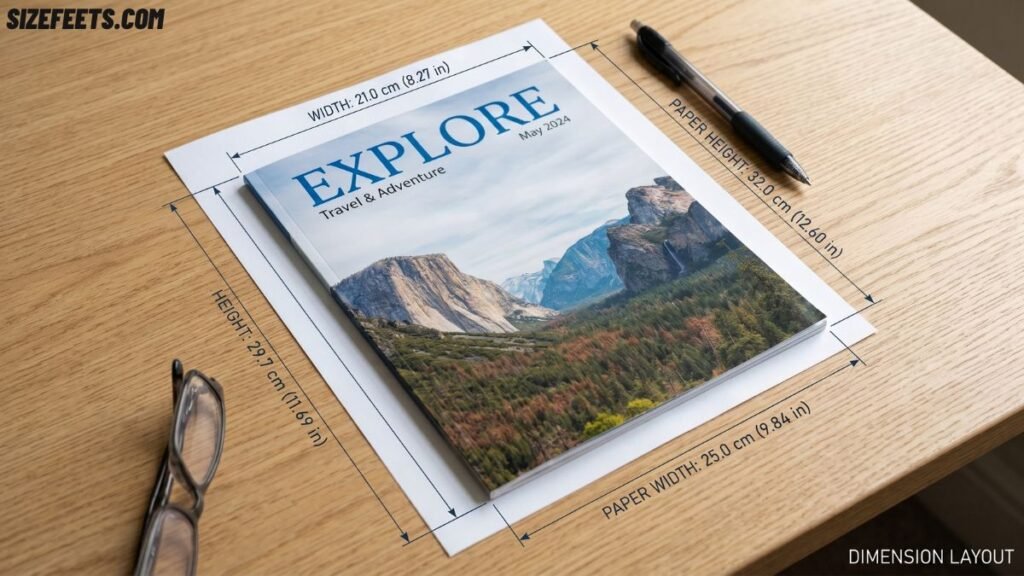
The closest match is a regular sheet of printer paper. US letter paper measures 8.5 × 11 inches, just slightly bigger than the magazine’s 8.375 × 10.875 inches. Lay a magazine on top of a sheet and you’ll see a thin border of paper peeking out on two sides.
This paper size is the standard for offices, schools, and home printers across the US and Canada. Magazines are trimmed a touch smaller so the printed edges come out clean after cutting. The small gap, about an eighth of an inch on each side, is easy to picture. Since almost every home keeps a stack of paper, a single sheet is the handiest way to picture a standard magazine size.
A Sheet of A4 Paper
A sheet of A4 paper is another close match. A4 measures 8.27 × 11.7 inches, so it’s a bit narrower and taller than a standard magazine. Place a magazine over an A4 sheet and the paper sticks out at the top but tucks in on the sides.
A4 is the standard paper size in most countries outside North America. It’s used for letters, reports, and printing worldwide. Because it’s shaped a little differently than letter paper, it shows how magazine size sits between the two common paper types. If you’re outside the US, an A4 sheet is an easy, always-available way to picture a magazine’s dimensions.
A File Folder

Read Also : How Tall Is a Red Bull Can? Size Guide With Real Comparisons
A standard file folder is close to a magazine in size. A letter-size folder measures about 8.5 × 11 inches when closed, just a bit larger than a standard magazine. Slide a magazine into a folder and it fits with a little room to spare.
File folders are made of stiff manila paper built to hold letter-size documents. They’re a staple in offices, filing cabinets, and home desks. Because they’re sized for letter paper, they closely match a magazine’s dimensions. If you keep folders around, one gives you a quick, familiar frame for picturing a standard magazine size, and it doubles as a handy way to store loose magazines flat.
A 13-Inch Laptop
A 13-inch laptop is close to a magazine in size. Open flat, a typical 13-inch laptop is about 12 inches wide and 8.5 inches deep, so its footprint is near a magazine’s dimensions, just turned sideways. Set a magazine next to a closed laptop and the sizes look similar.
The “13-inch” label refers to the screen measured on the diagonal, not the body. The laptop body is a bit wider than a magazine but similar in overall footprint. Because laptops are so common, one makes an easy everyday comparison. If you want to picture a standard magazine size, imagine a slim 13-inch laptop lying flat on a desk.
A Legal Pad
A legal pad is a bit taller than a standard magazine. A common letter-size legal pad measures about 8.5 × 11.75 inches, so it’s close in width but longer top to bottom. Lay a magazine on a pad and the pad extends past the bottom edge.
Legal pads are yellow ruled notepads used for notes and lists in offices and courts. They come in letter and legal sizes, with the letter size closest to a magazine. The extra height makes the pad a good “a little taller than” reference. Since many desks have one, a legal pad is a handy object to compare against a standard magazine size.
A Cereal Box Front
The front panel of a cereal box is a rough match. A standard box front measures roughly 8 × 12 inches, close to a magazine in width but a bit taller. Hold a magazine against the front of a cereal box and the widths look similar.
Cereal boxes come in many sizes, so this is an approximate match, not an exact one. The front panel is printed with bright art much like a magazine cover. Because a box is a common kitchen item, it’s a fun everyday reference. Next time you pour breakfast, picture the front of the box as roughly the size of a standard magazine, just a little longer.
A 12.9-Inch Tablet
A large tablet is close to a magazine in size. A 12.9-inch tablet measures about 11 × 8.5 inches, near a magazine’s dimensions when turned upright. Hold a magazine next to a big tablet and the two look similar in overall size.
The “12.9-inch” number is the screen measured on the diagonal. These large tablets are often used to read digital magazines, so the match makes sense. The tablet is a touch bigger than a standard magazine but very close. If you own a large tablet, it’s an easy tech-based way to picture a standard magazine size, since it’s built to display full magazine pages.
A Vinyl Record Sleeve
A vinyl record sleeve is bigger than a magazine, which makes it a good “larger than” reference. A standard LP sleeve measures about 12.4 × 12.4 inches, a square shape wider and taller than a magazine. Set a magazine on a record sleeve and there’s a border all around.
Record sleeves are square cardboard covers that protect 12-inch vinyl albums. Their large size gives room for cover art, much like a magazine spread. Because the sleeve is clearly bigger and square, it shows how a magazine is taller than it is wide. If you have records at home, a sleeve is an easy way to see that a standard magazine is smaller and more rectangular.
How to Measure a Standard Magazine Size Without a Ruler
No ruler handy? These simple tricks help you check a magazine’s size using things you already have.
Compare It to Letter Paper
A sheet of letter paper is the easiest check. Since letter paper is 8.5 × 11 inches, just lay your magazine on top of a sheet. If a thin strip of paper shows on two sides, about an eighth of an inch each, the magazine is the standard size. This works with any printer paper and needs no measuring at all. It’s the fastest way to confirm a magazine matches the common 8.375 × 10.875-inch trim.
Use a Dollar Bill
A US dollar bill can act as a rough ruler. A bill is 6.14 inches long and 2.61 inches wide. Lay the bill across the magazine’s width and it covers most of the 8.375-inch side, leaving about 2.25 inches uncovered. For the height, lay the bill end to end and the magazine runs a bit less than two bill-lengths tall. This gives a quick estimate using cash you already carry.
Count Credit Card Widths
A credit card gives you a known size to compare. Each card is 3.37 inches long. Line cards along the magazine’s width and about two and a half cards span the 8.375-inch side. Along the height, roughly three and a quarter cards reach the 10.875-inch top. Counting card-lengths lets you estimate the size without a ruler, using something from your wallet.
Standard Magazine Size vs. Other Common Sizes
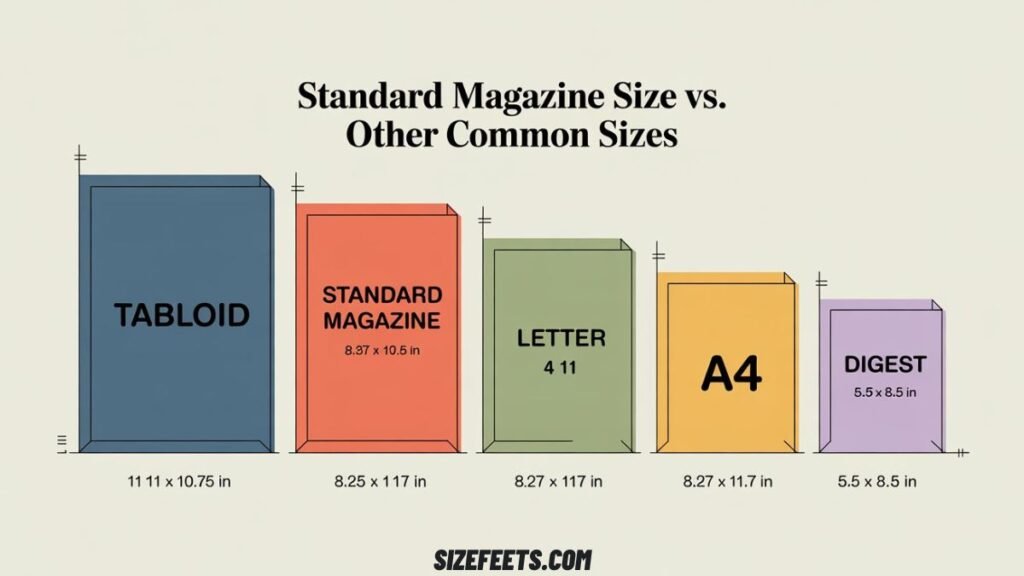
Seeing the standard magazine next to other formats helps it click. Letter paper is a bit bigger at 8.5 × 11 inches. A4 paper is narrower and taller at 8.27 × 11.7 inches. A digest-size magazine, like some smaller titles, is about 5.5 × 8.5 inches, roughly half the area. And a tabloid-size magazine is much larger at about 11 × 17 inches. So the standard magazine sits in the middle, close to a sheet of paper but smaller than a tabloid and bigger than a digest.
| Format | Size (inches) | Compared to Standard |
| Digest magazine | ~5.5 × 8.5 | About half the area |
| Standard magazine | 8.375 × 10.875 | The base size |
| Letter paper | 8.5 × 11 | Slightly bigger |
| A4 paper | 8.27 × 11.7 | Narrower, taller |
| Tabloid magazine | ~11 × 17 | Much larger |
Frequently Asked Questions
What is the standard size of magazines?
The standard US magazine size is 8.375 × 10.875 inches, or 21.3 × 27.6 cm. This is the trim size, just under a sheet of letter paper.
Are magazines A3 or A4?
Magazines are closer to A4, not A3. A4 is 21 × 29.7 cm, while A3 is much larger at 29.7 × 42 cm.
Is Vogue magazine A4 size?
Vogue is close to A4 but not exact. Its US print size runs near the standard 8.375 × 10.875 inches, a bit wider and shorter than a true A4 sheet.
Are standard magazines A4?
Not exactly. A standard US magazine is 8.375 × 10.875 inches, while A4 is 8.27 × 11.7 inches. The magazine is a bit wider and shorter than A4.
What is A1, A2, A3, and A4 in cm?
A1 is 59.4 × 84.1 cm, A2 is 42 × 59.4 cm, A3 is 29.7 × 42 cm, and A4 is 21 × 29.7 cm. Each size is half of the one before it.
What size is a digital magazine page?
A digital magazine page is often designed to the same 8.375 × 10.875-inch print trim, then shown on screen. Large tablets, like 12.9-inch models, display these pages well because their screens are close to full magazine size. The exact look depends on the device and the app used to read it.
Conclusion
Now you know the standard magazine size and how to picture it with ease. A US magazine measures 8.375 × 10.875 inches. That is 21.3 × 27.6 cm, or 213 by 276 mm. This is the trim size after the printer cuts the edges. It runs a little smaller than a sheet of letter paper. These few numbers cover almost everything you need to know.
You can also picture the size with simple objects. A sheet of letter paper is just a bit bigger. An A4 sheet is narrower and taller. A file folder holds one neatly as well. Keep in mind that digest magazines are smaller and tabloids are much bigger. With these easy comparisons, you can picture the standard magazine size anytime.



One Comment