
Miles to Steps Calculator: Convert Any Distance Fast
A miles to steps calculator turns a distance into a step count. It uses a simple rule. One mile is about 2,000 to 2,500 steps for most adults. Your height and stride change the number. Taller people take fewer steps per mile.
Have you ever wanted to know your steps without a tracker? You can do the math yourself. Just multiply your miles by about 2,000. A 5K comes to roughly 7,000 steps. Once you learn the rule, you can guess any distance.
The tool works for many distances. A kilometer is about 1,300 steps. 10,000 steps equals around 4 to 5 miles. Running takes fewer steps than walking. These simple numbers make a miles to steps calculator easy to use anytime.
Miles to Steps Calculator in Different Units
The core idea is simple. For an average adult, one mile equals roughly 2,000 to 2,500 steps when walking, or about 1,400 to 1,700 steps when running, since a running stride is longer. A mile is 5,280 feet, or 1.609 kilometers. Here’s how the conversion breaks down.
| Unit | Equivalent | Notes |
| 1 mile (walking) | ~2,000–2,500 steps | Varies by height and stride |
| 1 mile (running) | ~1,400–1,700 steps | Longer stride, fewer steps |
| 1 kilometer | ~1,250–1,550 steps | About 0.62 of a mile |
| 1 mile | 5,280 feet | Fixed distance |
| 1 mile | 1.609 km | Metric conversion |
| Average step length | ~2.1–2.5 ft | Depends on leg length |
Because stride length changes from person to person, treat every step count as an approximate. The simple rule most pedometers use is 2,000 steps per mile, which is a solid starting point.
Quick Reference Table
Want the fast version? This chart shows about how many steps common distances take when walking. All counts are approximate, since your stride sets the real number.
| Distance | Steps (Approx.) | Visual / Notes | Best For |
| 1 mile | ~2,000–2,500 | The core conversion | Everyday walks |
| 1 kilometer | ~1,250–1,550 | Just over half a mile | Metric distances |
| A 5K race | ~6,250–7,750 | 3.1 miles | Fun runs |
| A 10K race | ~12,400–15,500 | 6.2 miles | Longer races |
| 10,000 steps | ~4–5 miles | The daily goal | Step targets |
| One track lap | ~500–625 | 400 meters | Gym workouts |
| A football field | ~120–150 | 100 yards | Short bursts |
| A marathon | ~52,000–66,000 | 26.2 miles | Big goals |
| 5,000 steps | ~2–2.5 miles | Half the daily goal | Quick math |
| 2 miles | ~4,000–5,000 | Double a mile | Round trips |
8 Common Distances and How Many Steps They Take
Here are eight distances people know well, with about how many steps each one takes. These help you picture your step count without a tracker.
One Mile
A mile is the classic distance for this conversion. For most adults walking, one mile is about 2,000 to 2,500 steps, with 2,000 as the simple rule of thumb. Taller people take fewer steps, and shorter people take more, since stride length changes with leg length.
A mile is a fixed distance of 5,280 feet, set long ago as a standard unit. The step count varies because everyone walks a little differently. Your pace matters too, since a fast, long stride covers more ground per step. Fitness trackers and pedometers often default to 2,000 steps per mile, then adjust once they learn your stride. For a quick estimate, multiply your miles by 2,000 to get a rough step count.
One Kilometer
A kilometer is the metric cousin of the mile. Walking one kilometer takes about 1,250 to 1,550 steps for an average adult. That’s because a kilometer is shorter than a mile, at about 0.62 of a mile, or 1,000 meters.
The kilometer is the standard distance unit in most countries outside the US. Many races, like a 5K or 10K, use kilometers instead of miles. To convert, remember that one mile equals 1.609 kilometers. So if a mile is around 2,000 steps, a kilometer is roughly two-thirds of that. For metric distances, multiply your kilometers by about 1,300 to get a quick step estimate.
A 5K Race
A 5K is one of the most popular race distances. Walking a 5K, which is 3.1 miles, takes about 6,250 to 7,750 steps. Runners cover it in fewer steps, closer to 4,300 to 5,300, because their stride is longer.
The 5K, short for 5 kilometers, is a favorite for charity runs and first-time racers. It’s long enough to feel like a goal but short enough for most people to finish. Many training plans build up to a 5K over a few weeks. If you’re aiming for the 10,000-step daily goal, walking a full 5K gets you most of the way there in a single outing.
10,000 Steps
The 10,000-step goal is a common daily target. At an average stride, 10,000 steps equals about 4 to 5 miles of walking. The exact distance depends on your step length, so shorter strides cover less ground.
This goal became popular decades ago and stuck as an easy round number to aim for. Research shows real health benefits even below 10,000, so it’s a target, not a strict rule. Hitting it usually takes 30,000 to 40,000 feet of walking spread through the day. Breaking it into chunks, like a morning walk plus errands, makes it easier. To reverse the math, divide your step goal by 2,000 to 2,500 to see the miles.
One Lap Around a Track
Read Also : White Claw Can Size: Full Dimensions and Real Comparisons
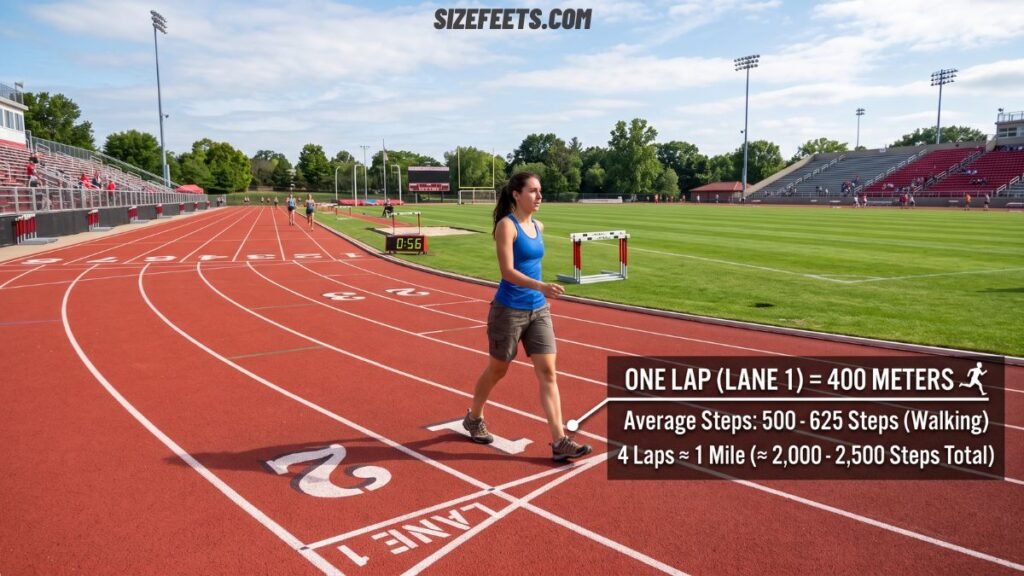
A standard running track is a handy short distance. One lap around the inside lane is 400 meters, which takes about 500 to 625 steps walking. Four laps make roughly one mile, so about 2,000 to 2,500 steps total.
Most outdoor tracks are built to this 400-meter standard, which is just under a quarter mile. The inside lane is the shortest path, and outer lanes are longer. Schools, parks, and gyms often have one, making it an easy place to measure your pace. If you count your steps for one lap, you can check your own stride against the average and fine-tune your personal step count.
A Football Field
A football field is a distance almost everyone can picture. The 100-yard playing field is 300 feet long, which takes about 120 to 150 steps to walk end to end. Add the end zones, and the full 120 yards takes a few more.
American football fields are built to this exact size, set by the sport’s rules. Because the length is standard, a field makes a great mental yardstick. Walking the field about 17 times would equal roughly one mile. This is a fun way to picture short distances in steps. Next time you watch a game, remember each length of the field is only around 130 steps.
A City Block

Read Also : What Weighs 1 Gram? 10 Tiny Everyday Objects
A city block is a familiar walking distance, though the length varies by city. A typical short block runs about 250 to 300 feet, which takes roughly 100 to 130 steps to walk. Longer blocks can take twice that or more.
Block sizes differ a lot between cities, so this is a loose guide. In many US cities, about 20 short blocks add up to one mile. Long crosstown blocks can be several times the length of short ones. Because of this, a city block is an approximate reference at best. Still, counting your steps for one block gives you a quick feel for how your stride adds up on a walk through town.
A Marathon
A marathon is the ultimate distance goal. At 26.2 miles, walking a full marathon takes about 52,000 to 66,000 steps, often cited around 55,000. Runners finish in fewer steps because of their longer stride.
The marathon distance comes from an old legend and was later fixed at 26.2 miles. It’s a huge test of endurance that takes months to train for. Most people who tackle one run it, but some walk the whole way. Completing a marathon means taking more steps in a few hours than many people take in several days. It’s a powerful reminder of how quickly steps add up over a long distance.
How to Convert Miles to Steps Without a Calculator
No app handy? These simple methods let you convert miles to steps in your head or with a quick measurement.
Use the 2,000-Step Rule
The fastest method is simple multiplication. Take your distance in miles and multiply by 2,000 to get a quick step count. So 3 miles is about 6,000 steps, and 5 miles is about 10,000. This uses the common pedometer default of 2,000 steps per mile. It’s a low estimate for shorter people, so you can multiply by 2,250 instead for a middle-of-the-road guess that fits most adults.
Measure Your Own Stride
For a personal number, measure your stride. Walk 10 normal steps and measure the total distance in feet with a tape measure. Divide that distance by 10 to get your step length. Then divide 5,280 feet by your step length to find your steps per mile. For example, a 2.4-foot stride gives about 2,200 steps per mile. This gives you a far more accurate count than the general rule.
Count a Known Distance
A track or field lets you check your count. Walk one lap of a 400-meter track and count your steps. Multiply that number by about four to estimate your steps per mile, since four laps make roughly a mile. You can do the same on a football field by counting one length and multiplying. This real-world test builds a step count that matches how you actually walk, not just an average.
Miles to Steps vs. Other Common Conversions
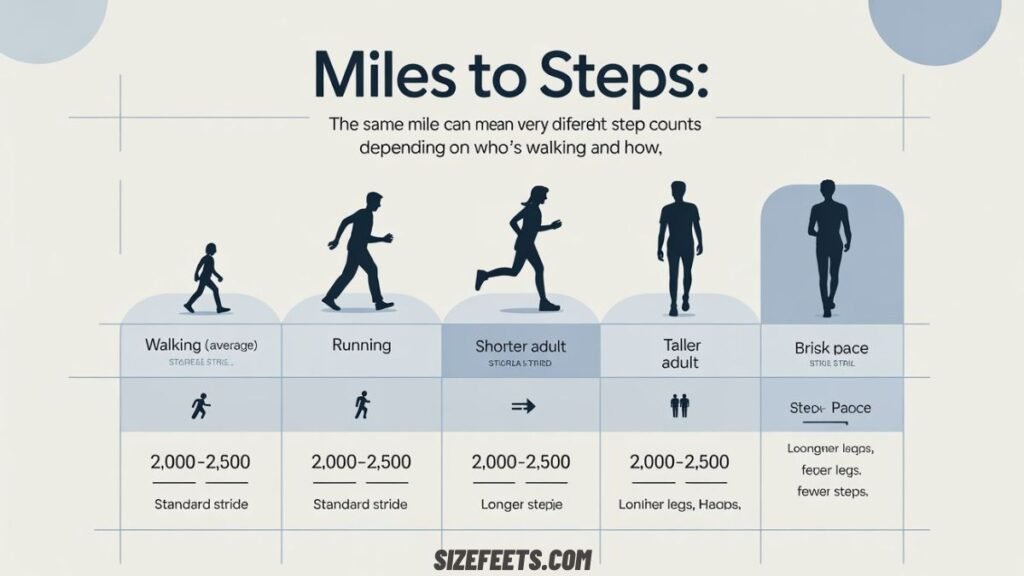
Seeing how the numbers shift helps build intuition. Walking takes more steps per mile, about 2,000 to 2,500, because the stride is shorter. Running takes fewer, around 1,400 to 1,700, since each stride reaches farther. Height matters too: a shorter adult may take 2,500 steps per mile, while a taller one takes closer to 1,900. And pace changes things, since a brisk walk stretches your stride. So the same mile can be very different step counts depending on who’s walking and how.
| Factor | Steps Per Mile | Why |
| Walking (average) | ~2,000–2,500 | Standard stride |
| Running | ~1,400–1,700 | Longer stride |
| Shorter adult | ~2,400–2,500 | Shorter legs, more steps |
| Taller adult | ~1,900–2,100 | Longer legs, fewer steps |
| Brisk pace | ~1,900–2,200 | Bigger stride at speed |
Frequently Asked Questions
How many steps is 1 mile?
One mile is about 2,000 to 2,500 steps for most adults walking. The simple rule of thumb is 2,000 steps per mile.
How many miles is 10,000 steps of walking?
10,000 steps of walking is about 4 to 5 miles for most adults. The exact distance depends on your height and stride length.
Is 5000 steps 2.5 miles?
Roughly, yes. 5,000 steps is about 2 to 2.5 miles for most walkers. At 2,000 steps per mile, it comes to 2.5 miles.
What is 5 miles in steps?
Five miles is about 10,000 to 12,500 steps for most adults walking. Using the simple rule of 2,000 steps per mile, it comes to 10,000.
Is 10,000 steps really 5 miles?
Roughly, yes. 10,000 steps equals about 4 to 5 miles, depending on your stride. At 2,000 steps per mile, it is exactly 5 miles.
How many steps is a marathon?
Walking a marathon of 26.2 miles takes about 52,000 to 66,000 steps, often cited around 55,000. Runners finish in fewer steps because of their longer stride. The huge total shows how quickly steps pile up over a long distance, even at an average walking pace.
Conclusion
Now you know how a miles to steps calculator works and how to use it with ease. The tool follows one simple rule. One mile is about 2,000 to 2,500 steps for most adults walking. The number 2,000 makes an easy starting point. Your height and stride shift the count a little. Taller people take fewer steps per mile than shorter people.
You can also do the math on your own. Just multiply your miles by about 2,000 for a quick guess. A 5K comes to roughly 7,000 steps. The 10,000-step goal equals about 4 to 5 miles. Measure your own stride for the most exact number. With this miles to steps calculator guide, you can turn any distance into steps anytime.





2 Comments