
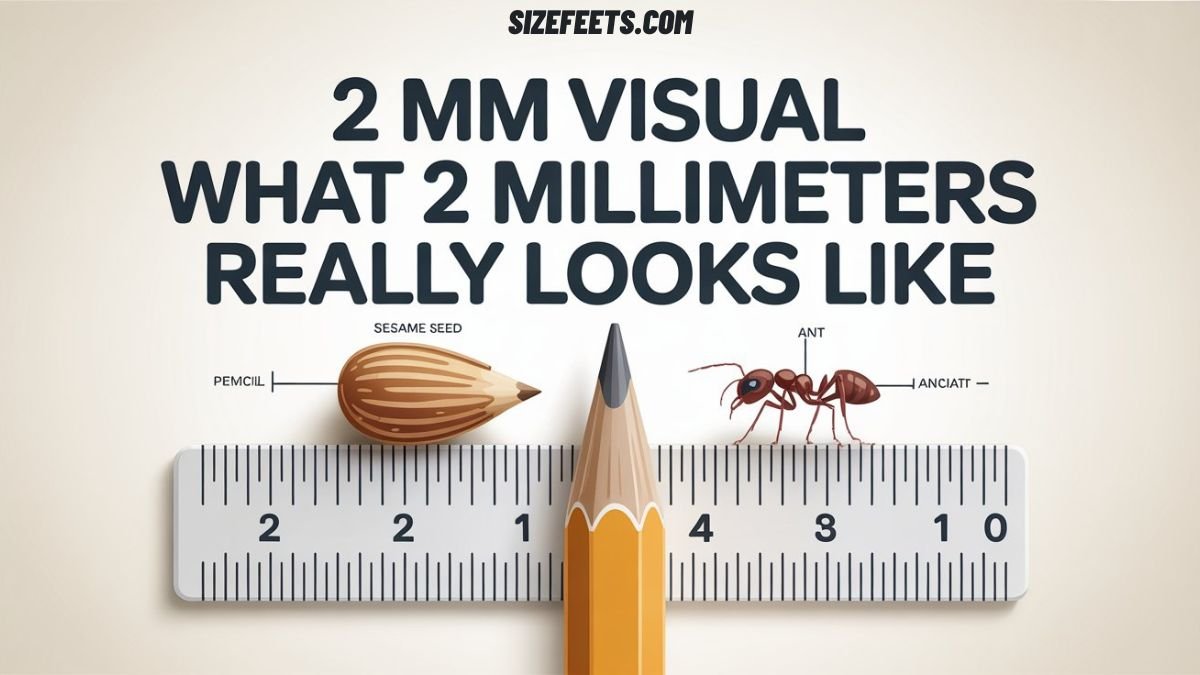
2 mm Visual: What 2 Millimeters Really Looks Like
A 2 mm visual is a way to picture how small 2 millimeters is. It equals about 0.079 inches. That is just under a tenth of an inch. In metric, it is 0.2 centimeters. Everyday objects show it best.
Have you ever needed to picture 2 mm with no ruler? You can use simple items instead. A nickel’s edge is almost exactly 2 mm. A pencil lead matches it too. Once you see these, you can picture 2 mm anytime.
Two millimeters is a very small length. A grain of rice is about 2 mm wide. A matchstick is close as well. Two credit cards stacked come near it. These simple objects make a 2 mm visual easy to picture.
2 mm Visual in Different Units
Two millimeters is a very small length. It equals about 0.079 inches, or just under 1/12 of an inch. In metric, that’s 0.2 centimeters or 2,000 microns. Here’s how 2 mm breaks down across the units people search for most.
| Unit | Equivalent | Notes |
| Millimeters | 2 mm | The base figure |
| Centimeters | 0.2 cm | One-fifth of a cm |
| Inches | ~0.079 in | Just under 1/12 inch |
| Fraction (inches) | ~5/64 in | Closest common fraction |
| Microns | 2,000 µm | For very fine work |
| Points (print) | ~5.7 pt | Used in typography |
| Pixels (96 dpi) | ~7.6 px | On a standard screen |
Because 2 mm is so small, it’s easier to picture with real objects than with numbers. A nickel is about 1.95 mm thick, which makes it one of the closest everyday matches.
Quick Reference Table
Want the fast version? These common items are close to 2 mm in thickness or width. The table is honest about which ones are exact and which are just close.
| Item | Exact or Approx. | Visual / Notes | Best For |
| A US nickel (thickness) | Approx. | ~1.95 mm | The closest match |
| Two stacked credit cards | Approx. | ~1.5 mm total | Thin stack cue |
| A standard pencil lead (2 mm) | Exact | 2 mm mechanical lead | Exact match |
| Two US dime thicknesses | Approx. | ~1.35 mm each | Coin stack cue |
| A stack of 2 pennies | Approx. | ~3 mm total | A bit thicker |
| A grain of rice (width) | Approx. | ~2 mm wide | Food cue |
| A ballpoint pen tip | Approx. | ~1 mm ball | Smaller cue |
| A guitar string (thick) | Approx. | ~1–2 mm | Music cue |
| A matchstick (thickness) | Approx. | ~2 mm | Everyday cue |
| A sesame seed (length) | Approx. | ~3 mm | A bit bigger |
8 Everyday Things That Are About 2 mm
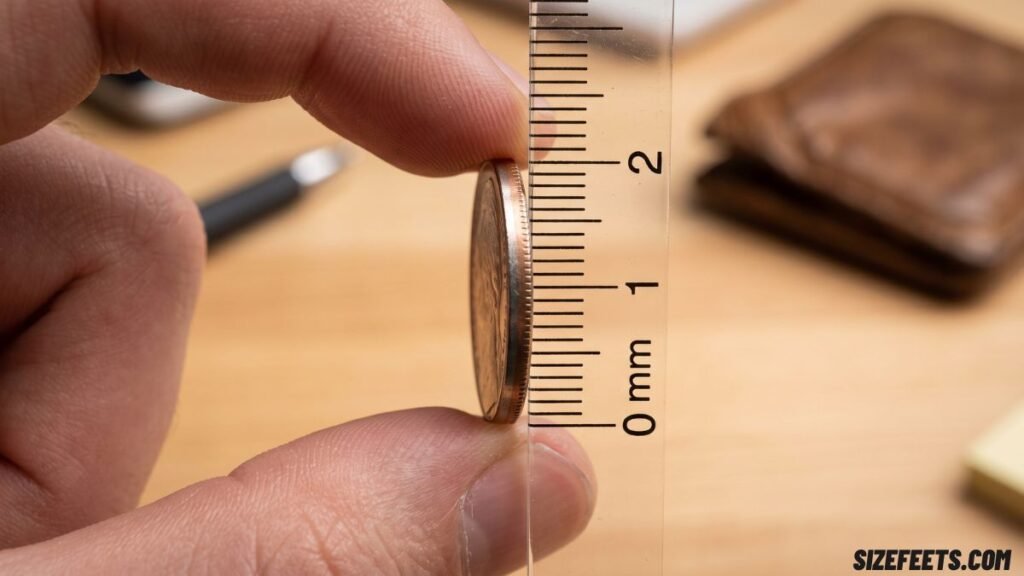
A US Nickel’s Thickness
Read Also : How Tall Is a 12 oz Can? Exact Height and Real Comparisons
The closest everyday match is the thickness of a US nickel. A nickel measures about 1.95 mm thick, just a hair under 2 mm. Hold a nickel on its edge and you’re looking at almost exactly 2 millimeters.
Nickels are made of a copper-and-nickel blend and have a steady, uniform thickness. Because coins are milled to precise specs, they make reliable tiny rulers. A nickel’s edge is the go-to reference for picturing 2 mm, since it’s so close to the mark. Keep one in your pocket and you always have a 2 mm guide on hand. It’s the easiest way to picture this small length without any tools.
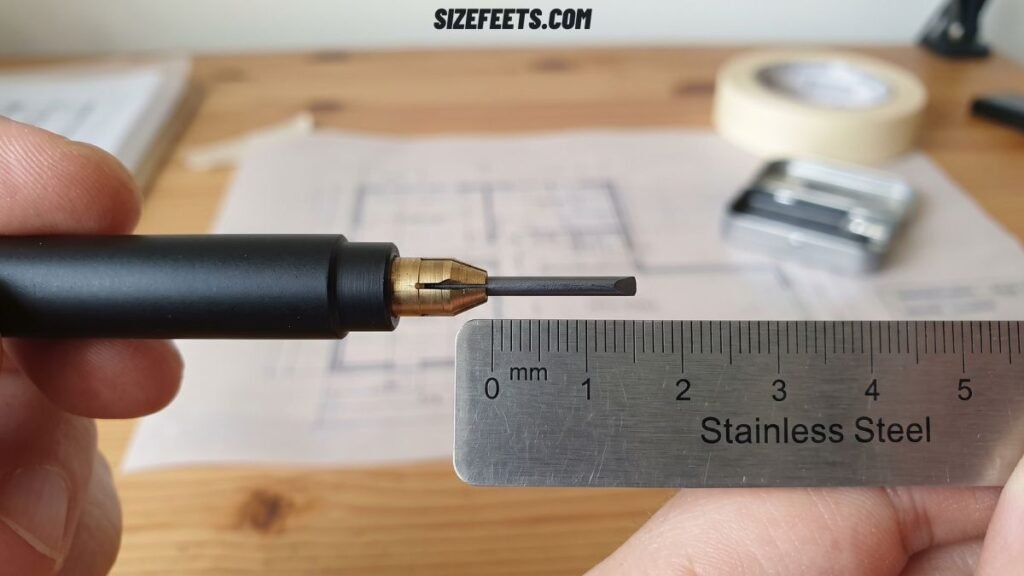
A 2 mm Pencil Lead
Read Also : Slim Can Koozie Dimensions: Exact Size Guide That Fits
A mechanical pencil lead gives you an exact match. Standard 2 mm lead, used in drafting pencils, measures exactly 2 millimeters across. Look at the tip of one and you’re seeing a perfect 2 mm width.
These thicker leads are common in clutch pencils and lead holders used for sketching and technical drawing. They come in a range of hardness grades, like HB and 2B. Because the lead is made to a precise 2 mm size, it’s one of the most accurate references you can find. If you have a drafting pencil, its lead shows you exactly what 2 mm looks like, no guessing needed.
Two Stacked Credit Cards
Two credit cards stacked are close to 2 mm. A single card is about 0.76 mm thick, so two stacked reach roughly 1.5 mm, a bit under 2 mm. Press two cards together and you’re near the mark.
Every credit card shares the same thickness, set by an international standard called ID-1. This makes them handy for measuring small heights. Because two cards fall just short of 2 mm, adding a third pushes past it. So two to three stacked cards bracket the 2 mm size. Since almost everyone carries cards, stacking a couple is an easy way to picture this tiny length.
A Grain of Rice
A grain of rice is close to 2 mm in width. A typical grain measures about 2 mm wide and 6 to 7 mm long. Look at a single grain from the side and its width is near the 2 mm mark.
Rice grains vary by type, from short and round to long and thin. The width stays fairly steady, though, near 2 mm for most kinds. Because rice is in almost every kitchen, a grain is a handy food-based reference. If you want to picture 2 mm, look at how wide a grain of rice is. It’s a small, everyday object that lands close to this tiny length.
A Matchstick’s Thickness
A wooden matchstick is close to 2 mm thick. A standard match measures about 2 mm across its square body. Look at the end of a matchstick and you’re seeing close to the 2 mm mark.
Matchsticks are cut from soft wood to a uniform size so they light and burn evenly. Their thin, square shape makes them a handy small ruler. Because the thickness is near 2 mm, a matchstick is an easy household reference. If you have a matchbook or box, pull one out and look at its end to picture 2 mm. It’s a common item that lands right around this small length.
A Stack of Two Dimes
Two dimes stacked are close to 2 mm plus a bit. A US dime is about 1.35 mm thick, so two stacked reach roughly 2.7 mm, a little over 2 mm. A single dime, at 1.35 mm, is a bit under the mark.
Dimes are the thinnest US coin, which makes them useful for fine measuring. One dime falls short of 2 mm, and two stacked go past it. So the 2 mm size sits between one and two dimes. Since spare change is easy to find, dimes give you a quick way to bracket this tiny length. Stack and compare to picture 2 mm.
A Thick Guitar String
A thick guitar string is close to 2 mm. The lowest, heaviest string on an acoustic guitar measures about 1.1 to 1.4 mm across, and a thick bass string can reach closer to 2 mm. Look at a low string end-on to picture a length near 2 mm.
Guitar strings come in gauges, measured in thousandths of an inch. The thickest wound strings on a bass guitar approach the 2 mm mark. Because strings are made to precise sizes, they’re a handy fine reference for musicians. If you play, look at your thickest string to picture close to 2 mm. It’s a small, exact object found in any music room.
A Sesame Seed
A sesame seed is a bit bigger than 2 mm, which makes it a good “just over” reference. A typical seed measures about 3 mm long and 2 mm wide. Look at a seed from the side and its width is right near the 2 mm mark.
Sesame seeds top bread, buns, and many dishes, so they’re a familiar food. Their small, flat shape makes them an easy tiny reference. The width lands close to 2 mm, while the length runs a bit longer. If you spot a sesame seed on a bun, look at how wide it is to picture 2 mm. It’s a common, everyday object at this small scale.
How to Picture 2 mm Without a Ruler
No ruler handy? These simple tricks help you picture 2 mm using things you already have.
Use a Nickel’s Edge
A nickel is the easiest 2 mm guide. Since a nickel is about 1.95 mm thick, its edge is almost exactly 2 mm. Hold the coin sideways and look at the thickness of its rim. That edge shows you the 2 mm mark with no measuring. Keep a nickel in your pocket or wallet and you always have a reliable 2 mm reference ready whenever you need to picture this small length.
Stack Coins or Cards
Stacking gives you a bracket around 2 mm. Two credit cards stacked reach about 1.5 mm, just under the mark, and three reach about 2.3 mm, just over. Two dimes stacked hit about 2.7 mm. By stacking common items, you can box in the 2 mm size from both sides. When your stack sits between these amounts, you’ve found close to 2 mm using everyday objects.
Look at a Pencil Lead
A drafting pencil gives an exact match. Standard 2 mm mechanical lead is made to precisely 2 millimeters across. Pull out a piece of lead and look at its width end-on. That’s exactly 2 mm, no estimating needed. This is the most accurate no-ruler method, since the lead is manufactured to that exact size. It’s a perfect reference for art, drafting, and craft work.
2 mm vs. Other Common Small Sizes
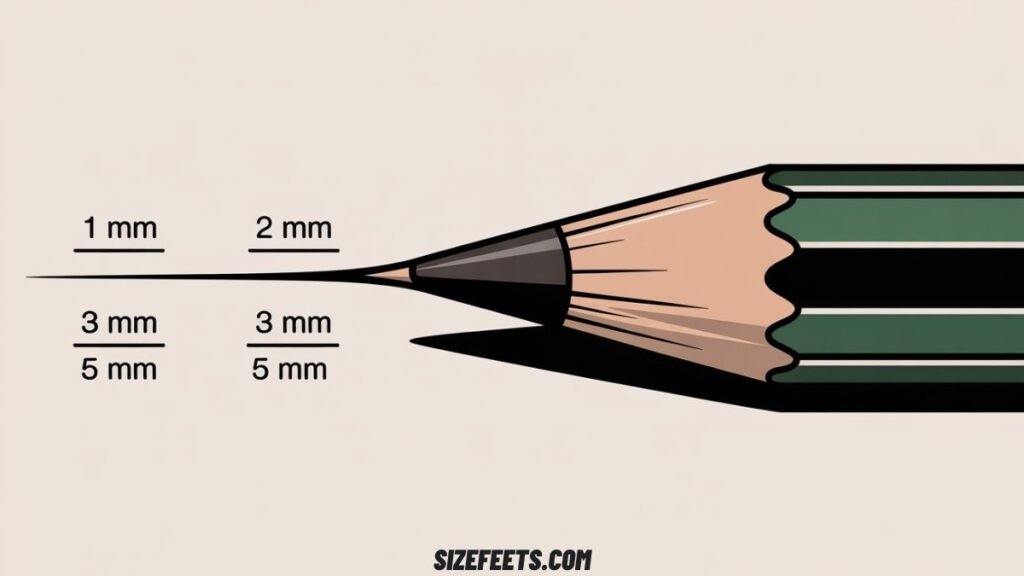
Seeing 2 mm next to nearby sizes helps it click. 1 mm is half of this, about the width of a sharp pencil point or a guitar’s thinnest string. 2 mm is our target, close to a nickel’s thickness. 3 mm is a bit more, about a stack of two pennies or a sesame seed’s length. And 5 mm is over double, close to the width of a pencil eraser. So 2 mm is a very small length, thicker than a pencil point but thinner than an eraser.
| Size | Compared to 2 mm | Everyday Example |
| 1 mm | Half | A sharp pencil point |
| 2 mm | The base size | A nickel’s thickness |
| 3 mm | A bit more | Two pennies or a sesame seed |
| 5 mm | Over double | A pencil eraser’s width |
| 10 mm (1 cm) | 5 times bigger | A fingernail’s width |
Frequently Asked Questions
How much is 2 mm visually?
2 mm is about the thickness of a US nickel, or 0.079 inches. It is just under a tenth of an inch.
What does 2 mm look like?
2 mm looks like a nickel’s edge or a 2 mm pencil lead. A grain of rice is about 2 mm wide too.
How big is 2 mm in size?
2 mm is a very small length, about 0.2 centimeters or 0.079 inches. It is just under a tenth of an inch.
How thick is 2mm?
2 mm is about as thick as a US nickel, which measures 1.95 mm. It is also close to a matchstick’s thickness.
How big is 2mm?
2 mm equals about 0.079 inches, or 0.2 centimeters. It is a tiny length, close to the thickness of a nickel.
What is 2 mm in pixels?
2 mm is about 7.6 pixels on a standard 96-dpi screen. The exact number changes with screen resolution, since higher-dpi displays pack more pixels per millimeter. For print at 300 dpi, 2 mm is about 24 pixels. So the pixel count depends on the device you’re using.
Conclusion
Now you know the 2 mm visual and how to picture it with ease. Two millimeters equals about 0.079 inches. That is just under a tenth of an inch. In metric, it is 0.2 centimeters. A US nickel’s edge is almost exactly 2 mm. These few facts cover almost everything you need to know.





One Comment