
How Long Is a Dollar Bill? Exact Size and Real Comparisons
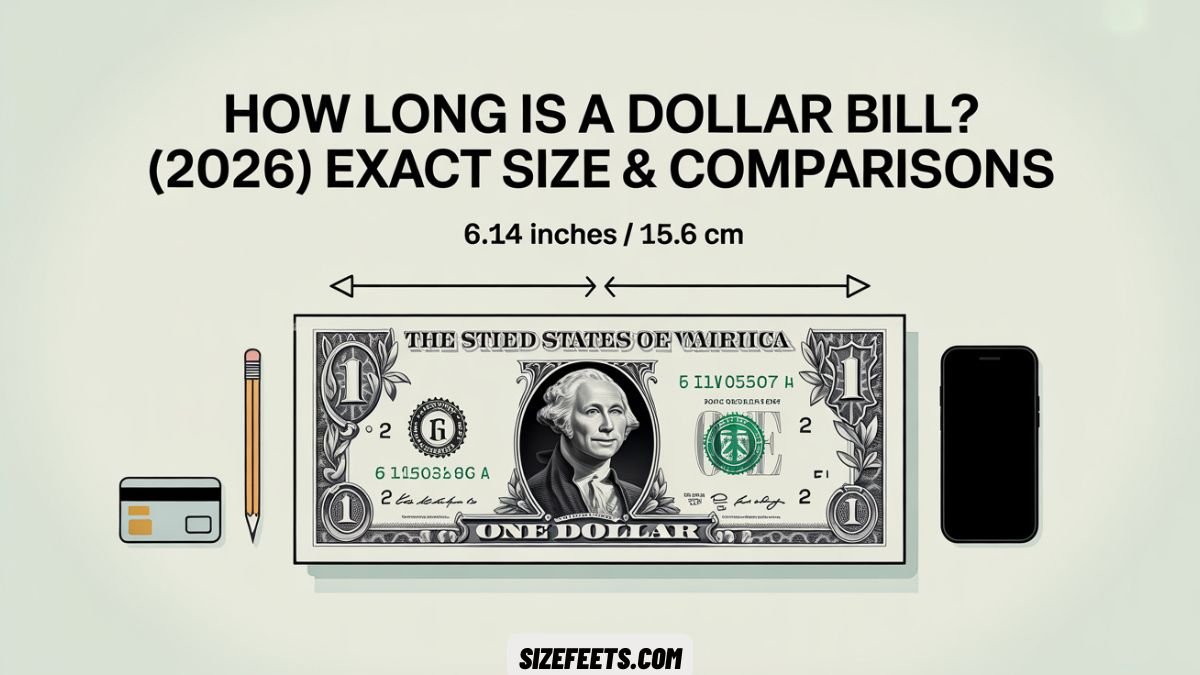
How long is a dollar bill is a common way to picture a short length. A dollar bill is 6.14 inches long. That is 15.6 cm. It is also 2.61 inches wide. Every US bill shares this exact size.
Have you ever needed a ruler but only had cash? Your wallet can help. A dollar bill is just over half a foot long. You can even fold it for smaller marks. Once you know its size, you can measure almost anything.
Every US note is the same size by law. A $1, $5, and $100 bill all match. The paper is a tough cotton-and-linen blend. Two bills in a line reach about one foot. This makes a bill a handy backup ruler.
How Long Is a Dollar Bill in Different Units
The size is fixed by law, so every note is the same. A US dollar bill measures 6.14 inches long and 2.61 inches wide, which is 15.6 cm by 6.6 cm. It’s also about 0.0043 inches thick. Here’s how the length breaks down across the units people search for most.
| Unit | Equivalent | Notes |
| Inches (length) | 6.14 in | The long side |
| Centimeters (length) | 15.6 cm | Exact metric match |
| Millimeters (length) | 156 mm | For fine measuring |
| Inches (width) | 2.61 in | The short side |
| Centimeters (width) | 6.6 cm | Short-side metric |
| Feet | ~0.51 ft | About half a foot |
| Thickness | ~0.11 mm | Very thin paper |
Every US bill, from the $1 to the $100, shares this exact size. That uniform shape is what makes a bill such a handy backup ruler.
Quick Reference Table
Want the fast version? These common items are close to a dollar bill’s length or width. The table is honest about which ones are exact and which are just close.
| Item | Exact or Approx. | Visual / Notes | Best For |
| Any US bill ($5, $20, $100) | Exact | Same size as a $1 | The direct twin |
| A new pencil | Approx. | ~7.5 in, a bit longer | Picturing length |
| A credit card (×1.8) | Approx. | 3.37 in each | Length in cards |
| A ballpoint pen | Approx. | ~5.5 in, a bit shorter | Length cue |
| A soda can (height) | Approx. | 4.8 in, shorter | Height compare |
| A US quarter (width) | Approx. | ~0.96 in wide | Small-scale cue |
| A standard envelope | Approx. | 4.125 × 9.5 in | Mail reference |
| A smartphone | Approx. | ~6 in tall | Length compare |
| A sticky note | Approx. | 3 × 3 in | Width cue |
| A AA battery (length) | Approx. | ~2 in, much shorter | Tiny compare |
6 Everyday Things That Are About a Dollar Bill’s Size
Here are six objects that help you picture a dollar bill’s length or width. A few match closely, and the rest sit near enough to compare without a ruler.
Any Other US Bill
Read Also : How Much Is 300 g? Everyday Objects That Weigh It
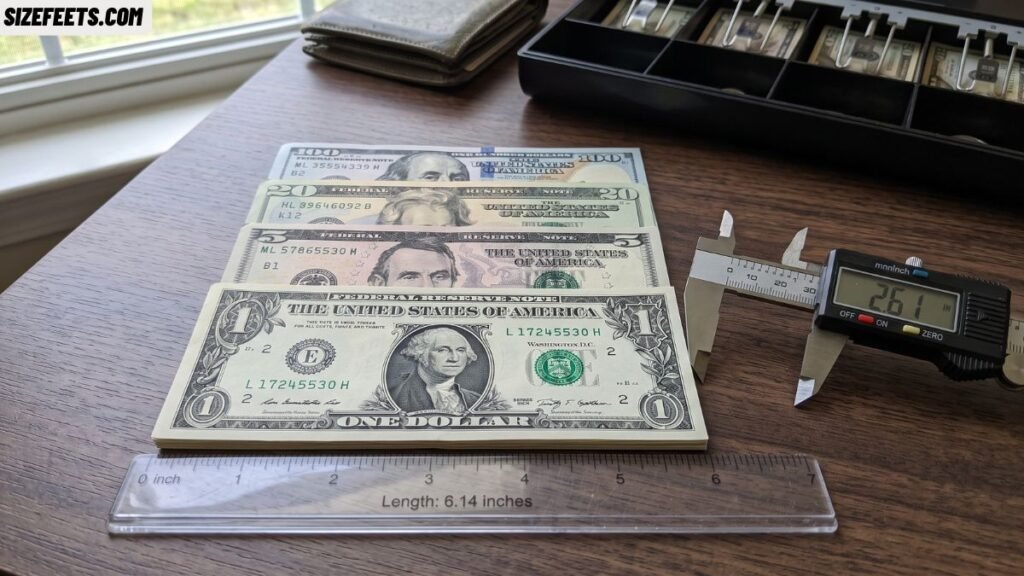
The easiest match is any other US paper bill. A $5, $20, or $100 note all measure the exact same 6.14 inches long and 2.61 inches wide as a $1. Stack any bills together and the edges line up perfectly.
The US Bureau of Engraving and Printing makes every note the same size to keep vending machines, cash drawers, and wallets simple. This has been the standard since 1929, when bills were made smaller than the older, larger notes. The paper is a blend of 75% cotton and 25% linen, which makes it tough and hard to tear. Because every bill matches, any note in your wallet works as a 6.14-inch ruler.
A New Pencil
A brand-new pencil is a bit longer than a dollar bill. A standard unsharpened pencil measures about 7.5 inches, compared with the bill’s 6.14 inches. Lay a bill next to a fresh pencil and the pencil sticks out by more than an inch.
Pencils have been made to this length for over a century, mostly for a comfortable grip and easy sharpening. The core is graphite mixed with clay, not real lead. As you sharpen a pencil, it gets shorter, so a used one can match a bill’s length closely. For a rough measure, a new pencil is a touch over one dollar bill, which helps you picture both lengths at once.
Two Credit Cards End to End
Read Also : How Much Is 500 Grams? Everyday Objects That Weigh It
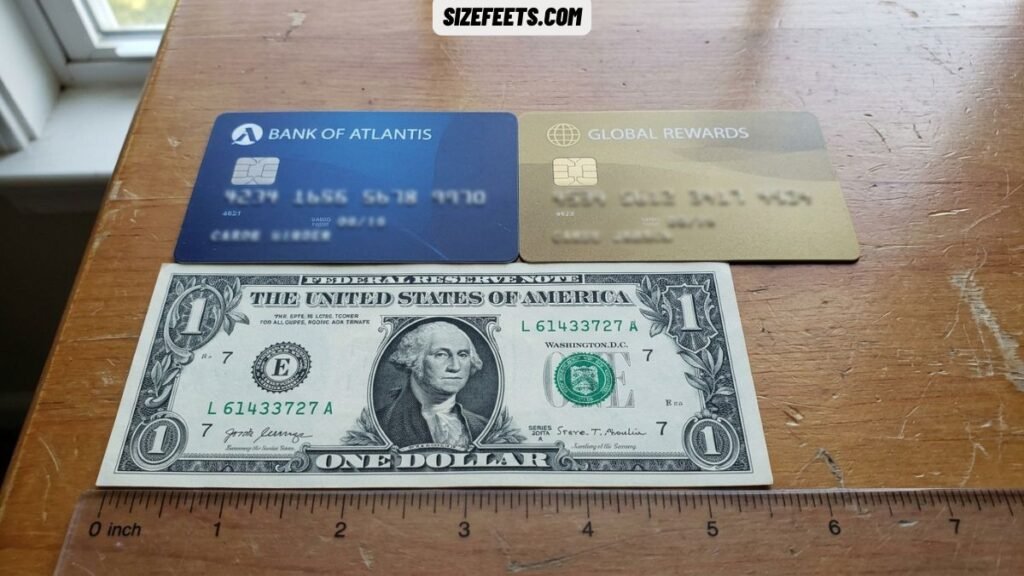
Two credit cards laid in a line are close to two-thirds longer than a bill. A standard card measures 3.37 inches long, so two end to end reach about 6.74 inches, just over the bill’s 6.14 inches. Line up a bill under two cards to see the small gap.
Every credit card, debit card, and gift card shares this exact size, set by an international standard called ID-1. That’s why they all fit the same wallet slots and card readers. The cards are made of layered plastic, often PVC, pressed and printed to last for years. Since almost everyone carries a card, two of them make a handy way to check a length near 6 inches.
A Ballpoint Pen
A standard pen is a little shorter than a dollar bill. A typical ballpoint pen measures about 5.5 inches, compared with the bill’s 6.14 inches. Set a pen on top of a bill and the bill sticks out past the pen’s tip.
Pens come in slightly different lengths by brand, but most everyday ones land near this size. The plastic or metal barrel holds a thin tube of quick-drying ink. Because pens sit in every desk drawer, backpack, and bag, they make a quick and easy length cue. When you need to picture 6 inches, remember a dollar bill is just a bit longer than a common pen.
A Standard Business Envelope
A regular business envelope is longer than a dollar bill. A common #10 envelope measures about 9.5 inches long and 4.125 inches tall, so a bill fits easily inside with room to spare. Slide a bill into an envelope and you’ll see the extra space.
These envelopes are the standard size for mailing letters and bills in the US. They’re built to hold a sheet of paper folded into thirds. The dollar bill’s 6.14-inch length is shorter than the envelope’s long side but longer than its short side. Since most homes keep envelopes around, one gives you a familiar frame for comparing the length of a dollar bill.
A Smartphone
A typical smartphone is close to a dollar bill in length. Many phones stand about 6 inches tall, very near the bill’s 6.14 inches. Hold a bill next to your phone and the two lengths nearly match.
Phone sizes vary by model, with larger ones running a bit taller and smaller ones shorter. The body is usually glass and metal or plastic, built around the screen inside. Because a phone is always in hand or pocket, it’s an easy everyday object to compare against a bill. For a fast mental picture, a dollar bill is about as long as a standard smartphone stood upright.
How to Measure With a Dollar Bill Instead of a Ruler
No ruler nearby? A dollar bill is a built-in measuring tool. These simple tricks help you use one to check lengths around the house.
Use the Long Side for 6 Inches
The long edge of a bill is your quick 6-inch mark. Since a dollar bill is 6.14 inches, its length is just a hair over half a foot. Lay the bill flat against the object you want to measure and line up one end. For longer items, flip the bill end over end and count how many bill-lengths fit. Two bills laid in a line reach about 12.3 inches, which is close to one foot.
Use the Short Side for 2.6 Inches
The short edge gives you a handy 2.6-inch guide. Turn the bill sideways and use its width to measure smaller objects. This width is nearly the same as a soda can’s diameter, so a bill can check round items too. Fold the bill in half the short way and you get about 1.3 inches. Folding lets you measure in smaller steps without needing a ruler at all.
Fold It for Smaller Marks
Folding turns one bill into many sizes. Fold the long side in half to get about 3.07 inches. Fold it again for roughly 1.5 inches. Each fold cuts the length in half, giving you smaller and smaller marks. This trick is useful for measuring short gaps or small objects. Just keep the folds neat and even, and you can estimate many lengths with a single bill.
How Long Is a Dollar Bill vs. Other Common Sizes
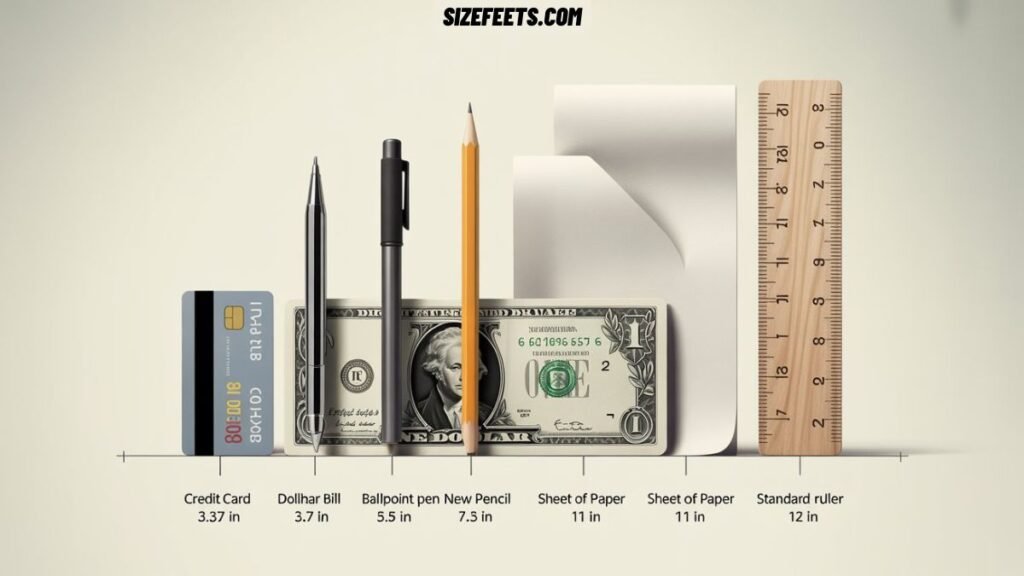
Seeing a dollar bill next to other lengths helps it stick. A credit card is shorter at 3.37 inches, about half a bill’s length. A new pencil is longer at 7.5 inches. A standard ruler runs 12 inches, roughly two bills laid end to end. And a sheet of paper is 11 inches on its long side, a bit shorter than two bills. So a dollar bill sits right in the middle, longer than a card but shorter than a ruler.
| Item | Length | Compared to a Dollar Bill |
| Credit card | 3.37 in | About half as long |
| Ballpoint pen | ~5.5 in | A bit shorter |
| Dollar bill | 6.14 in | The base length |
| New pencil | ~7.5 in | A bit longer |
| Sheet of paper (long side) | 11 in | Almost two bills |
| Standard ruler | 12 in | About two bills |
Frequently Asked Questions
Is a dollar bill 6 inches long?
Almost, a dollar bill is 6.14 inches long, just a hair over 6 inches. For a rough estimate, you can treat it as 6 inches.
How long is a $20 bill in inches?
A $20 bill is 6.14 inches long, the same as every US note. All bills share this exact size, so a $20 matches a $1.
How long is a $100 bill?
A $100 bill is 6.14 inches long and 2.61 inches wide. It is the same size as every other US paper bill.
How long is a 1 dollar bill in cm?
A 1 dollar bill is 15.6 cm long and 6.6 cm wide. Every US note shares this exact metric size.
How tall is a 1$ bill?
A $1 bill is 2.61 inches (6.6 cm) tall on its short side. This is the width of the note when held flat.
Is a dollar bill 6 inches long?
Almost. A dollar bill is 6.14 inches long, just a hair over 6 inches. For a quick estimate, you can treat it as 6 inches, but the exact length is 6.14 inches. That small extra fraction adds up over several bills, so use the full number for careful measuring.
Conclusion
Now you know how long is a dollar bill and how to picture it with ease. A dollar bill is 6.14 inches long and 2.61 inches wide. That is 15.6 cm by 6.6 cm. Every US note shares this exact size, from the $1 to the $100. The law sets these dimensions, so all bills match perfectly. This makes a bill a handy backup ruler.
You can also use a bill to measure many things. Its long side gives you just over half a foot. Two bills laid end to end reach about one foot. You can even fold a bill for smaller marks. Keep one in your wallet, and you will know how long is a dollar bill anytime you need it.




One Comment